
Digital marketing has always evolved alongside new technology, and another major shift is now on the horizon with the arrival of chatgpt ads. For more than a decade, businesses have relied on search engines and social platforms to reach customers, but advertising inside an AI conversation introduces a completely different way for brands to be discovered. Instead of interrupting a user while they browse, chatgpt ads are designed to appear within a relevant discussion at the exact moment someone is asking questions and looking for solutions.
This change matters because consumer behaviour is already moving away from traditional search boxes. People are increasingly using AI tools to plan purchases, compare products, and get recommendations in plain language. When that same environment begins to include sponsored placements, the rules of engagement will be different from Google Ads or social media advertising. Businesses that understand these differences early will have a strong advantage.
For Australian brands, the introduction of chatgpt ads represents both an opportunity and a challenge. The opportunity lies in reaching highly motivated audiences who are actively seeking guidance. The challenge is that success will depend less on bidding for keywords and more on understanding intent, messaging, and conversion experience. This article explores what chatgpt ads are expected to look like, how they may be targeted, and what businesses should do to prepare.
What ChatGPT Ads Is and What It Is Not
There is already plenty of speculation about how chatgpt ads will operate, and some of it is based on assumptions drawn from older forms of digital advertising. It is important to understand that this environment is not the same as display banners, pop ups, or even traditional search results. Chatgpt ads are expected to sit separately from the AI generated response, clearly labelled as sponsored content, rather than being mixed into the answer itself.
Unlike social media feeds where advertising competes for attention, chatgpt ads are designed to appear only when there is genuine relevance to the conversation. If someone is asking for advice about laptops, travel options, or home services, a related sponsored placement may appear beneath the response. If the discussion is about personal matters, sensitive topics, or general knowledge with no commercial intent, no advertising would be shown. This approach makes the experience feel closer to a helpful recommendation than a disruptive promotion.
It is also not a keyword auction in the traditional sense. Search engines rely heavily on individual phrases typed into a box, while chatgpt ads are expected to be driven by overall context and meaning. The system interprets what the user is trying to achieve and matches that intent with an advertiser that can provide a relevant solution. For businesses used to managing long lists of keywords, this will require a different mindset focused on customer problems and outcomes rather than isolated search terms.
Another important distinction is privacy. Early information suggests that personal conversations will not be shared with advertisers and that users will have control over any form of personalization. Chatgpt ads are intended to operate within a privacy first framework, using aggregated data and contextual signals instead of detailed individual profiling. This is a significant departure from the tracking heavy model that has dominated digital marketing for years.
How Targeting Is Expected to Work
The way chatgpt ads are targeted is likely to be one of the biggest differences compared with existing advertising platforms. Rather than relying on rigid keyword lists or audience segments built from past behaviour, targeting is expected to revolve around the live conversation taking place. This means the system looks at the topic being discussed and matches an advertiser that can genuinely help at that moment.
The first layer is contextual targeting. When a user asks about a product, service, or problem with a commercial angle, chatgpt ads can be shown that relate directly to that subject. A conversation about renovating a home could trigger an ad for local builders, while a discussion about accounting software might display a sponsored placement from a finance platform. The relevance comes from the meaning of the dialogue, not from a single search phrase.
The second layer is intent based targeting. AI conversations are richer than short search queries, so the platform can understand whether someone is researching, comparing options, or ready to take action. Chatgpt ads shown to a user asking for the best options will be different from those shown to someone requesting prices or booking details. This ability to read intent is what makes the channel potentially powerful for advertisers who focus on solving real customer needs.
A third layer may involve optional personalization. Users are expected to have control over whether any previous interactions influence the ads they see. If personalization is enabled, the system could refine which chatgpt ads appear based on earlier topics or preferences. If it is disabled, targeting would rely purely on the current conversation. This flexibility is designed to balance relevance with user privacy.
There are also likely to be guardrails around sensitive categories. Advertising next to discussions about health, politics, or personal issues may be restricted or excluded altogether. For businesses, this means chatgpt ads will work best in practical, solution driven markets such as retail, travel, education, trades, and professional services where intent is clear and commercial.
What the Ads May Look Like
Although the final design will evolve over time, early information gives a reasonable picture of how chatgpt ads are expected to appear on screen. The most important point is that they will not be embedded inside the AI answer itself. Instead, a sponsored placement is likely to sit beneath the response in a clearly marked box so users can easily distinguish between information and advertising.
The visual style is expected to be simple rather than flashy. Traditional display advertising relies on bright banners and heavy graphics to capture attention, but chatgpt ads will probably resemble recommendations with concise text, a brand name, and a direct link. The goal is to feel helpful and relevant rather than disruptive, matching the conversational nature of the platform.
A practical example helps illustrate this. If a user asks for advice on choosing a family holiday destination, the AI may provide general guidance about locations and travel tips. Below that answer a chatgpt ad from a travel company could appear offering package deals or accommodation options. The ad would not influence the content of the response, but it would be positioned at the moment the user is most receptive to taking the next step.
This placement model also means creative strategy will be different. Instead of designing large visual assets, advertisers will need to focus on clear messaging that aligns with the question being asked. Chatgpt ads are likely to reward businesses that can communicate value quickly, highlight trust signals, and direct users to landing pages that continue the helpful experience.
For brands used to social media advertising, this will feel closer to search intent than to scrolling behaviour. The audience is already engaged in a decision making process, and the ad simply offers a logical path forward. That is why many marketers believe chatgpt ads could become one of the most qualified forms of digital traffic available.
Conversion Tracking and Measurement
For any new advertising channel, the first question businesses ask is how results will be measured. Chatgpt ads are expected to follow the same fundamental principles as other digital platforms, focusing on impressions, clicks, and conversions, but the method behind the scenes is likely to be more privacy conscious and based on first party data.
When a chatgpt ad is displayed, an impression would be recorded in the advertiser dashboard. If the user clicks the sponsored placement and visits the advertiser website, that click can be tracked in a similar way to search advertising today. The key difference is that personal conversations are not shared with advertisers, so measurement will rely on aggregated reporting rather than individual level profiles.
Conversions such as purchases, enquiries, or bookings are expected to be tracked through the advertiser’s own website using familiar tools like analytics tags or server side events. This means businesses that already run Google Ads or Meta Ads will need a similar setup to measure the impact of chatgpt ads. Strong landing pages and accurate conversion tracking will be just as important as the ad placement itself.
Attribution may also work on a modelled basis. Because the platform prioritises user privacy, some results could be estimated using statistical methods rather than direct identifiers. For advertisers, the focus will shift from following a single user journey to understanding overall performance trends and return on investment.
What matters most is that chatgpt ads should still be accountable. Marketers will want to see which messages generate the most clicks, which landing pages convert best, and how this channel compares with search and social campaigns. Businesses that prepare their analytics early will be in the best position to evaluate whether chatgpt ads deserve a larger share of budget.
What This Means for Australian Businesses
For Australian businesses, the arrival of chatgpt ads could open a completely new path to customers who are already in research and decision mode. Unlike social platforms where users are primarily there for entertainment, people using AI tools are often asking practical questions about products, services, and next steps. This intent driven environment can be valuable for brands that rely on enquiries, bookings, or online sales.
Certain industries are likely to benefit first. E commerce retailers, travel providers, education institutions, trades, and professional services all deal with customers who ask detailed questions before making a decision. Chatgpt ads have the potential to reach those users at the exact moment they are comparing options. For local businesses, this could become another powerful channel alongside Google Ads and organic search.
It is important to see this as a complement rather than a replacement. Search engines will continue to capture demand from people typing short queries, while social media will remain effective for awareness and remarketing. Chatgpt ads sit in between these two worlds, targeting users who want guidance in plain language. A balanced strategy that connects all channels is likely to deliver the best results.
Competition may also look different. Early adopters who test chatgpt ads before the platform becomes crowded could achieve lower costs and stronger visibility, similar to the early days of Google Ads. Businesses that wait too long may find that the channel matures quickly and becomes more competitive.
The key message for Australian brands is to stay informed and prepared. Even if chatgpt ads are not yet available to every advertiser, understanding how the system works will help businesses adapt their messaging, landing pages, and tracking so they are ready when the opportunity arrives.
How to Prepare Before Ads Go Live
Even though chatgpt ads are still in the early stages, businesses do not need to wait to start preparing. The fundamentals that will make this channel successful are the same elements that already drive strong performance in search and social advertising: clear offers, helpful content, and a smooth conversion experience.
The first priority is messaging. Because chatgpt ads are expected to appear alongside specific questions, businesses should think about the real problems their customers describe in everyday language. Ads that simply push a brand name are unlikely to perform as well as those that directly answer a need and explain the benefit in a few simple lines.
Landing pages will play a critical role. When someone clicks a chatgpt ad they are coming from a conversational environment where they expect clarity and guidance. Pages that continue that helpful tone, provide quick answers, and make the next step obvious are far more likely to convert. Long, confusing pages built only for search rankings may struggle in this new context.
Analytics and tracking should also be reviewed in advance. Businesses will need reliable conversion measurement on their own websites to understand the value of chatgpt ads. Setting up proper goal tracking, enquiry forms, and ecommerce reporting now will make it easier to test the channel when it becomes available.
Finally, companies should adopt a testing mindset. No one yet knows which industries, messages, or formats will perform best. Starting with small experiments, learning from the data, and refining the approach will be essential. The brands that treat chatgpt ads as an ongoing optimisation project rather than a one off campaign are likely to see the greatest return.
ODM Perspective
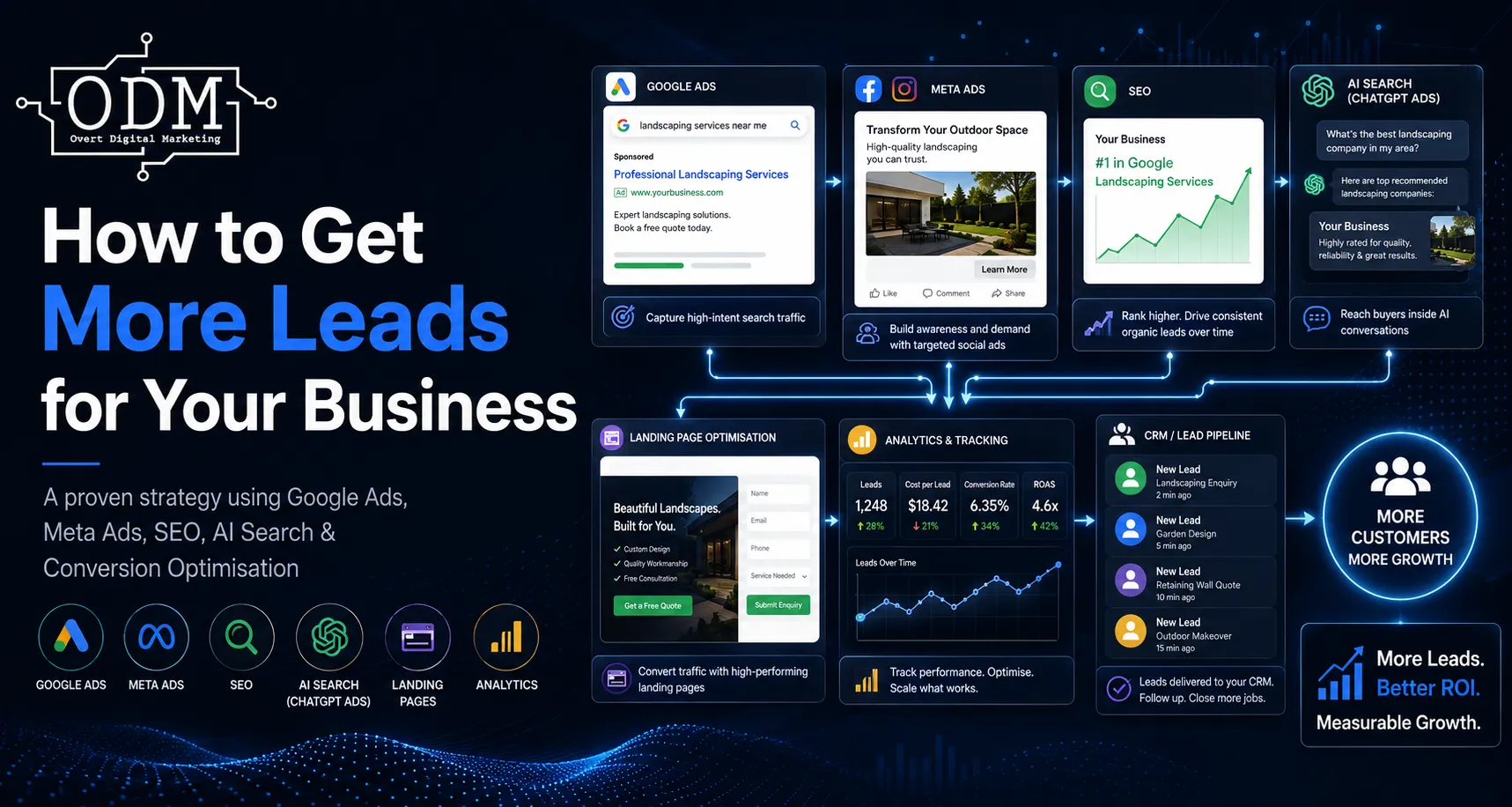
At Overt Digital Marketing (ODM) we view chatgpt ads as the next step in the ongoing shift toward intent driven marketing. Our experience across Google Ads, Meta Ads, and SEO has shown that the businesses who succeed are those that focus on understanding customer questions rather than chasing platforms. This new channel follows the same principle, only in a more conversational environment.
Our approach has always been to test emerging opportunities carefully and protect client budgets. When chatgpt ads become widely available, the goal will not be to move spending blindly but to run controlled experiments, compare results with existing channels, and scale what proves profitable. The fundamentals of strong offers, clear landing pages, and accurate tracking remain the foundation.
We also see this as an opportunity to connect different parts of a marketing strategy. Insights from chatgpt ads can inform search campaigns, website content, and even social messaging. Because the platform is built around real questions, it provides a unique window into how customers describe their needs in natural language.
For businesses already working with ODM, preparation will involve reviewing current conversion paths, refining value propositions, and ensuring analytics are ready for a new traffic source. For new clients, chatgpt ads will become part of a broader performance plan rather than a stand alone experiment.
Our focus will remain the same as it has always been: generating measurable leads, enquiries, phone calls, and sales. If chatgpt ads can contribute to that outcome, we will help clients adopt the channel in a practical and results focused way.
Final Thoughts
The introduction of chatgpt ads signals another turning point in digital marketing. As consumers move toward AI tools for advice and decision making, businesses will need to meet them in that environment with helpful, relevant messages rather than traditional interruptions. The brands that adapt early are likely to benefit from highly engaged audiences and intent driven traffic.
While many details will continue to evolve, the direction is clear. Chatgpt ads will reward businesses that understand their customers, communicate value simply, and provide seamless online experiences. Companies that rely on outdated tactics or ignore the shift may find themselves losing visibility to more agile competitors.
For Australian businesses, this is an opportunity to rethink how marketing fits into the customer journey. Instead of chasing clicks, the focus can return to answering real questions and guiding people toward the right solution. That is where long term growth will come from.
If you would like to explore how chatgpt ads could fit within your current digital strategy, ODM can help you prepare. We can review your website, conversion tracking, and messaging so your business is ready when the channel opens to advertisers. Get in touch with the ODM team to discuss a practical, performance focused approach tailored to your goals.
By Manesh Ram, Digital Marketing Specialist. Please follow @maneshram & Meta