
The conversation around advertising inside AI platforms has shifted rapidly over the past year, and few developments have sparked as much curiosity as ads appearing within ChatGPT. For users, it raises questions about privacy, experience, and trust. For marketers, it opens the door to a completely new kind of advertising environment, one that sits inside conversations rather than alongside content.
In our view, this is not just another ad placement channel. It represents a fundamental shift in how people discover products, services, and recommendations. Instead of scrolling through feeds or searching on Google, users are now asking questions and expecting direct answers. That changes everything about how ads need to work.
This article breaks down how ads in ChatGPT actually function, where they appear, how they are controlled, and what this means for both users and advertisers moving forward.
A New Kind of Advertising Environment
Traditional digital advertising has always been built around interruption. Whether it is banner ads, social media placements, or search ads, the goal has been to insert a message into a user experience that is already happening. ChatGPT flips that model.
Here, users are not browsing or scrolling. They are actively asking questions and seeking specific answers. That means advertising has to be more contextual, more relevant, and less intrusive.
It is clear that the platform has been designed with this in mind. Ads are not embedded directly into answers in a way that manipulates or alters the response. Instead, they exist as clearly separated elements that complement the conversation rather than distort it.
This distinction matters more than most people realise.
Do ChatGPT Ads Influence ChatGPT Responses
One of the biggest concerns users have is whether advertising affects the answers they receive. This is where the platform draws a very clear line.
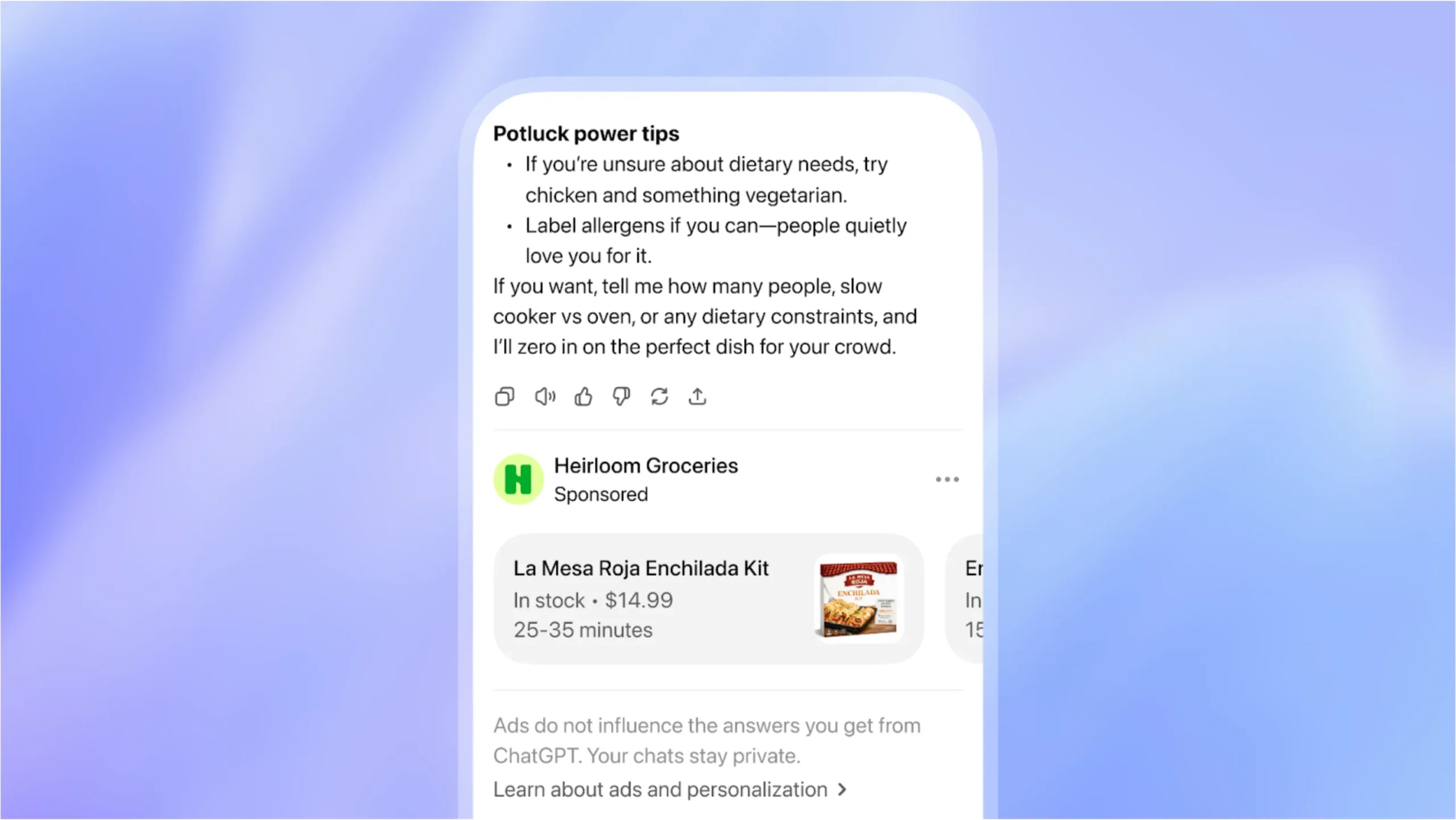
Ads do not influence the answers ChatGPT gives you.
This is not just a marketing statement. It is a structural separation between the AI system generating responses and the advertising layer that sits alongside it. The answers you receive are generated independently of any advertiser input or influence.
In practical terms, that means if you ask for the best marketing strategies, business tools, or product recommendations, the response is not being shaped to favour advertisers. The ad experience is separate, and this separation is essential for maintaining trust.
We think this is one of the most important decisions in the evolution of AI driven platforms. Without that separation, user confidence would collapse quickly.
Where Ads Appear in ChatGPT
Unlike traditional platforms where ads are scattered throughout feeds or pages, ChatGPT keeps things structured and predictable.
When ads appear, they are always clearly labeled as sponsored content. They are also visually separated from the organic answer, which makes it easy for users to distinguish between what is part of the AI response and what is paid promotion.
This design approach does a few important things:
- It preserves the integrity of the conversation. Users can focus on the answer without feeling like it has been blended with advertising messaging.
- It creates transparency. There is no ambiguity about what is an ad and what is not.
- It aligns with how people naturally interact with conversational interfaces. You do not want ads interrupting the flow of a discussion. Instead, they should feel like optional additions that users can engage with if they are relevant.
In our view, this is a far more sustainable model than the cluttered environments we see on social platforms.
How Ads Are Personalised Without Compromising Privacy
Personalisation is where things get interesting. Users expect relevant ads, but they also expect their privacy to be protected. ChatGPT attempts to balance both.
Ads are personalised using information that stays within the ChatGPT environment. This can include the types of ads you have interacted with previously and the context of your conversations.
However, and this is critical, your personal details and conversations are not shared with advertisers.
Advertisers do not have access to your chats, chat history, stored memories, or any personal data tied to your account. Instead, they receive aggregated performance insights such as total impressions, clicks, and general engagement metrics.
This is a major departure from how advertising works on many other platforms.
It is clear that the goal here is to provide relevance without surveillance. In our view, this is the direction the entire digital advertising ecosystem is heading, especially as privacy regulations tighten globally.
What Advertisers Actually See
From a marketer perspective, the data available is intentionally limited.
Advertisers do not get to see individual user interactions or identify specific users. They are working with high level performance data. This includes how many people saw an ad, how many engaged with it, and overall trends in performance.
While this might seem restrictive compared to platforms like Meta or Google, it forces a shift in strategy.
Instead of relying heavily on granular targeting and retargeting, advertisers need to focus on creative quality, message clarity, and contextual relevance.
We think this is actually a positive change. It pushes marketers back toward fundamentals rather than over reliance on data exploitation.
User Control Over the Ad Experience
One of the more important aspects of ads in ChatGPT is user control.
Users are not passive recipients of advertising. They have the ability to influence the types of ads they see through their interactions. If you engage with certain categories of ads, the system learns from that behaviour to improve relevance.
At the same time, users can provide feedback on ads, including whether they are relevant or not. This feedback loop helps refine the experience over time.
There are also controls available to manage ad preferences and reduce exposure to irrelevant content. While the specifics may evolve, the core idea is that users are not locked into a fixed ad experience.
In our view, this level of control is essential. It aligns with modern expectations where users want transparency and agency over how platforms operate.
Why This Matters for Businesses and Marketers
From a digital marketing standpoint, ChatGPT ads represent a new frontier.
The biggest shift is intent. Users are not passively consuming content. They are actively asking questions. That means ads need to align with intent rather than interrupt it.
For example, if a user is asking about the best CRM systems for small businesses, an ad that appears in that context has a much higher chance of being relevant and effective.
This creates a more qualified interaction compared to traditional display advertising.
However, it also raises the bar for advertisers. Poorly targeted or low quality ads will stand out immediately in a conversational environment.
We think this will lead to better advertising overall. Brands will need to focus on providing genuine value rather than just grabbing attention.
The Balance Between Monetisation and Trust
Every platform that introduces ads faces the same challenge. How do you monetise without damaging the user experience?
ChatGPT approach is heavily focused on maintaining trust. The clear labeling of ads, the separation from organic responses, and the privacy protections all contribute to this.
It is clear that the platform understands the risk of eroding user confidence. If users start to believe that answers are influenced by advertisers, the entire value proposition collapses.
In our view, maintaining this balance will be the defining factor in the success of ads within conversational AI platforms.
What the Future Might Look Like
Looking ahead, it is likely that ads in ChatGPT will become more sophisticated.
We may see deeper contextual relevance, better creative formats, and more seamless integration into the user experience without compromising transparency.
At the same time, privacy will remain a central focus. Users are becoming more aware of how their data is used, and platforms that prioritise privacy will have a competitive advantage.
For marketers, this means adapting early. Understanding how conversational intent works, how to craft messages that fit naturally into this environment, and how to measure success without relying on invasive tracking will be key.
In conclusion, Ads in ChatGPT represent a significant shift in digital advertising. They are not just another placement option. They are part of a broader evolution toward conversational discovery.
It is clear that the platform has been designed to prioritise user trust, transparency, and privacy. Ads do not influence the answers you receive, they are clearly labeled and separated, and your personal data remains protected.
In our view, this is a step in the right direction for the industry. It challenges outdated models and pushes both platforms and advertisers to do better.
For users, it means a cleaner and more controlled experience. For businesses, it means new opportunities but also new expectations.
The real question is not whether ads in ChatGPT will work. It is how quickly brands can adapt to this new way of connecting with people.
If you would like to explore how chatgpt ads could fit within your current digital strategy, ODM can help you prepare. We can review your website, conversion tracking, and messaging so your business is ready when the channel opens to advertisers. Get in touch with the ODM team to discuss a practical, performance focused approach tailored to your goals.
By Manesh Ram, Digital Marketing Specialist. Please follow @maneshram & Meta