
Search behaviour is changing.
Potential customers are increasingly asking AI tools such as ChatGPT, Google Gemini and Perplexity to recommend businesses, compare products, explain differences between providers and help them make purchasing decisions.
That creates a new visibility challenge for marketers.
Traditional SEO tools can tell you where a website ranks in Google, which keywords generate traffic and how competitors are performing in organic search.
What they generally do not tell you is whether ChatGPT recommends your business, whether Gemini mentions a competitor instead, or which sources Perplexity relies on when answering a commercially relevant question.
That is the problem HubSpot AEO is designed to address.
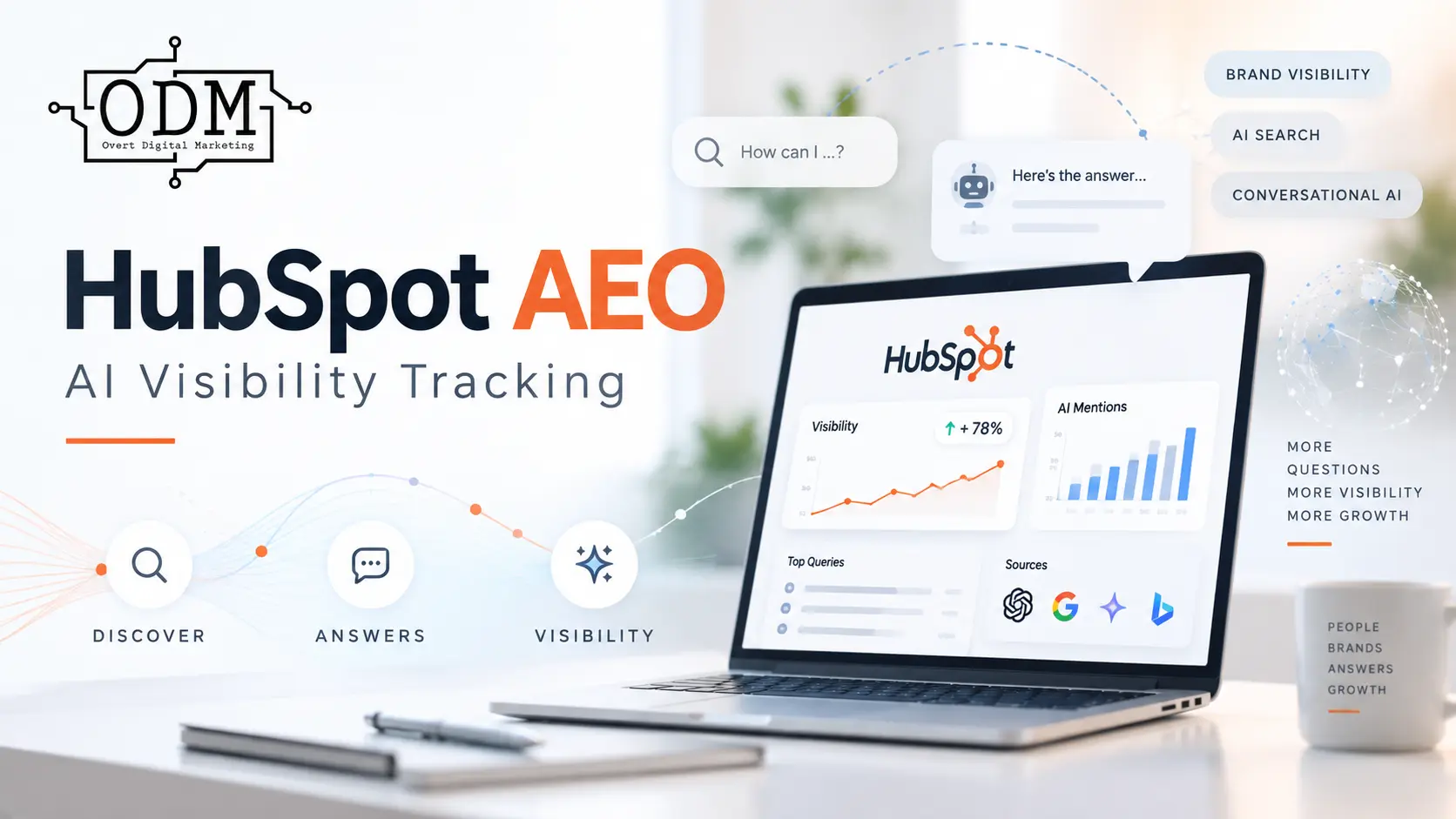
HubSpot AEO monitors how a brand appears across selected AI engines, tracks visibility against competitors, identifies the sources being cited and analyses how the brand is being described.
It can also help marketers identify gaps and opportunities based on the questions potential customers are asking.
For businesses already investing in SEO, Answer Engine Optimisation and Generative Engine Optimisation, that kind of data can be extremely useful.
But there is an important distinction.
Tracking AI visibility does not improve AI visibility by itself.
Knowing that a competitor appears in 70% of relevant answers while your business appears in 20% is useful information. The real value comes from understanding why that difference exists and what needs to change.
That could involve improving website content, strengthening topical authority, earning better third-party citations, addressing technical issues or creating content that answers commercially relevant buyer questions more effectively.
HubSpot AEO therefore works best as a measurement and intelligence layer within a broader SEO, AEO and GEO strategy.
The question is not simply whether the tool can track your visibility.
It is whether the insights it produces are useful enough to help your business become more visible when potential customers turn to AI for answers.
What Is HubSpot AEO?
HubSpot AEO is an AI visibility monitoring tool designed to show how often a business appears when potential customers ask questions through conversational AI platforms.
Rather than tracking traditional keyword rankings, HubSpot AEO monitors prompts across ChatGPT, Google Gemini and Perplexity and records whether a brand is mentioned in the responses.
It also compares visibility against selected competitors, identifies the sources being cited and analyses how the brand is being described.
This gives marketers a different view of online visibility.
Traditional SEO tools might tell you that a page ranks third for a keyword such as “best accounting software for small business”.
HubSpot AEO can help answer a different question:
When someone asks ChatGPT, Gemini or Perplexity which accounting software they should consider, does your brand appear in the answer?
That distinction matters because AI-driven research is increasingly conversational.
Potential buyers may ask questions such as:
“Which CRM is best for a small professional services business?”
“What are the best alternatives to HubSpot?”
“Which patio builders in Brisbane are worth considering?”
“Which software is better for a growing ecommerce business?”
These are not always traditional search queries. They are often detailed, comparison-based questions that reflect where the buyer is in the decision-making process.
HubSpot AEO is designed to monitor those kinds of questions over time.
The tool can then show whether the brand is appearing, which competitors are being surfaced instead, what sources AI engines are relying on and whether there are recurring gaps in the brand’s visibility.
That makes HubSpot AEO primarily a measurement and intelligence tool.
It helps businesses understand how they currently appear across selected AI platforms.
Improving that visibility still requires work across content, SEO, AEO, GEO, authority building and third-party citations.
How Does HubSpot AEO Work?
HubSpot AEO works by tracking a defined set of buyer questions, or prompts, across ChatGPT, Google Gemini and Perplexity. Those prompts are monitored on an ongoing basis so marketers can see whether their brand appears in the answers, how often competitors are mentioned and which sources the AI engines rely on when generating their responses.
The starting point is the prompt set. Unlike traditional SEO, where marketers often begin with keywords, AEO monitoring is built around conversational questions that reflect how potential customers actually research products and services. A prompt might ask which provider is best for a specific need, how two products compare, which businesses operate in a particular location or what factors a buyer should consider before making a decision.
HubSpot then runs those prompts across the supported AI engines and records the responses. From there, it calculates visibility metrics, compares the brand against selected competitors and identifies recurring patterns. If a competitor appears consistently across a group of commercially relevant questions while your business rarely appears, that gives you a clearer indication of where the visibility gap exists.
The tool also examines the sources being cited. This can help show whether AI engines are relying on a competitor’s own website, review platforms, directories, media coverage, comparison articles or other third-party sources. That information can be more useful than the visibility score itself because it starts to explain why one brand is being surfaced more often than another.
For businesses using HubSpot Marketing Hub Professional or Enterprise, the platform can also use CRM data and existing customer context to help suggest relevant prompts. That can make the monitoring more commercially meaningful because the questions can be aligned with actual buyer personas, products, services and stages of the customer journey rather than relying only on generic category terms.
The result is a feedback loop. HubSpot shows where the brand is appearing, where competitors are stronger, which sources AI engines are using and what content opportunities may exist. The marketing team can then act on those insights through content, SEO, AEO, GEO and authority-building activity before monitoring the same prompts again to see whether visibility improves over time.
That is the real value of the tool. It turns AI visibility from something anecdotal into something that can be tracked, compared and acted on.
What AI Engines Does HubSpot AEO Track?
HubSpot AEO currently tracks visibility across three major AI platforms: ChatGPT, Google Gemini and Perplexity. These are the engines HubSpot uses to monitor whether a brand appears in response to the buyer questions and prompts being tracked.
The advantage of this approach is simplicity. Rather than spreading monitoring across a very large number of AI surfaces, HubSpot focuses on three platforms that are already playing a significant role in how people research products, services and providers. For many businesses, that is enough to establish a useful baseline for AI visibility and compare how often the brand appears relative to competitors.
There is, however, an important limitation. HubSpot AEO does not currently provide the same breadth of engine coverage as some specialist AI visibility platforms. Businesses that specifically want to monitor additional environments such as Claude, Microsoft Copilot or a wider range of AI search experiences may find the coverage too narrow for their needs.
That does not necessarily make HubSpot AEO less useful. The right level of coverage depends on where the business’s customers are actually conducting research. A company whose audience primarily uses ChatGPT, Gemini and Perplexity may gain more value from focused monitoring across those platforms than from tracking a much larger number of engines that are less relevant to its market.
The key is to understand that HubSpot AEO provides a selective view of AI visibility rather than a complete view of every AI-powered discovery environment. For businesses using the tool, those three engines should therefore be treated as important indicators rather than the entire AI search landscape.
What Does HubSpot AEO Measure?
HubSpot AEO measures more than whether a brand appears in an AI-generated answer. It looks at several signals that help marketers understand how visible the business is, how that visibility compares with competitors and what may be influencing the result.
One of the main metrics is brand visibility, which shows how often the business appears across the prompts being tracked. If the brand is mentioned in a high proportion of relevant responses, that indicates stronger visibility across the monitored AI engines. If it appears rarely, the data helps identify where the gaps are.
The tool also measures competitor visibility and share of voice. This is useful because AI visibility only becomes meaningful when it is viewed in context. A business appearing in 30% of tracked responses may sound reasonable until a competitor is appearing in 70% of the same questions. That comparison helps marketers understand which brands are currently dominating the conversation.
Another important area is citation analysis. HubSpot identifies the sources AI engines use when mentioning a brand or competitor. These may include the company’s own website, review platforms, directories, editorial articles, industry publications or other third-party sources. This information is particularly valuable because it can reveal which websites AI systems appear to trust when forming their answers.
HubSpot also tracks sentiment and narrative. It can help show how the business is being described across AI responses, including recurring perceptions around areas such as pricing, reliability, product quality, customer service or particular strengths and weaknesses. A brand may be highly visible but still be represented in a way that does not support its positioning, so visibility alone is not enough.
Finally, the tool monitors prompt-level performance. This allows marketers to see which questions consistently surface the brand, which questions favour competitors and where the business is missing completely. Over time, those patterns can be used to prioritise content, authority-building and other marketing activity around the questions that matter most commercially.
The strength of HubSpot AEO is therefore not any single score. It is the combination of visibility, competitor presence, citations, sentiment and prompt performance that starts to explain how a brand is being represented across AI-driven research.
Why Citation Analysis May Be More Important Than Visibility Alone
Knowing that your brand appears in AI-generated answers is useful, but knowing why it appears is often more valuable.
That is where citation analysis becomes important.
If ChatGPT, Gemini or Perplexity mentions a competitor more often than your business, the first instinct might be to create more content. But the visibility gap may not be caused by a lack of content on your own website. The AI engine may be relying on third-party sources that consistently reinforce the competitor’s authority.
Those sources could include industry publications, review websites, directories, comparison pages, Reddit discussions, partner websites or the competitor’s own content.
HubSpot AEO helps identify those citation patterns.
For example, if a competitor is repeatedly surfaced because AI engines are citing a respected industry directory, that suggests a different action from simply publishing another blog article. The opportunity may be to improve the business’s presence in that directory, strengthen third-party coverage or build authority in the same areas that are influencing the AI response.
The same applies to owned content.
If an AI engine consistently cites one of your service pages, guides or articles, that tells you which content is already helping the brand appear. That content can then be expanded, updated or supported with stronger internal and external authority signals.
This is why citation analysis is particularly important for GEO.
AI visibility is not only about having the right words on a website. It is also about whether AI systems can find enough credible evidence across the web to support mentioning or recommending the brand.
A visibility score tells you where you stand.
Citation analysis starts to tell you why you are there.
For marketers, that second question is often the more valuable one because it points directly towards the actions that can improve future visibility.
What Are HubSpot’s Recommendations?
HubSpot AEO does more than report where a brand appears. It also turns visibility gaps, citation patterns and competitor performance into recommendations that marketers can act on.
These recommendations can help identify where new content may be needed, which existing pages could be improved and what types of topics or buyer questions deserve more attention. For businesses using HubSpot’s broader marketing and content tools, those recommendations can also feed directly into content creation workflows.
That integration is useful because it shortens the gap between insight and execution. Instead of identifying an opportunity in one platform and then manually translating it into a content brief somewhere else, marketers can move more quickly from AI visibility data into content updates, blog ideas or campaign activity.
However, the recommendations should not be followed blindly.
A tool can identify that a competitor is appearing more frequently for a certain prompt, but it cannot fully understand the commercial importance of that question, the quality of the competitor’s offer or whether targeting that topic is actually worthwhile for the business.
The same applies to content recommendations. Publishing more content is not automatically the right answer. The visibility gap may instead be caused by weak authority, limited third-party citations, poor technical accessibility or a lack of trusted external references.
This is where strategy still matters.
HubSpot AEO can highlight the opportunity, but marketers still need to assess the likely commercial value, the competitive landscape and the most effective way to respond.
The strongest use of the tool is therefore not to treat recommendations as instructions. It is to use them as evidence that helps guide broader SEO, AEO, GEO and content decisions.
How Does HubSpot Use CRM Data for AEO?
One of HubSpot AEO’s strongest advantages is its ability to use existing customer and CRM context to help shape the questions being monitored.
For businesses using HubSpot Marketing Hub Professional or Enterprise, the platform can draw on information already stored in HubSpot, including audience segments, buyer personas and other customer context, to suggest prompts that are more closely aligned with how real prospects research and make decisions.
That matters because the quality of the prompt set has a major influence on the value of any AEO monitoring program.
A generic question such as “best CRM software” may be useful, but it can also be extremely broad. A more specific question such as “best CRM for a growing professional services business with a small sales team” may be far more commercially relevant if that reflects the type of customer the business actually wants to attract.
The same principle applies across almost every industry.
A patio company may learn more from tracking “best patio builder for an insulated patio in Brisbane” than simply monitoring “best patio builder”. A training provider may gain more value from a question tied to a specific qualification, location or buyer need than from tracking a broad category term.
By using CRM context to inform prompt suggestions, HubSpot can help move AEO monitoring closer to actual buyer behaviour rather than treating it as a simple list of AI search terms.
This is an important distinction because prompts are not the same as keywords.
Keywords are usually short search phrases. AEO prompts are often more detailed, conversational and tied to a specific decision, problem or stage of the buying journey.
The more closely those prompts reflect the questions commercially valuable customers are actually asking, the more useful the visibility data becomes.
That is where the CRM connection can add real value. Instead of only asking, “Does our brand appear in AI answers?”, the business can ask a more useful question:
“Does our brand appear when the right type of customer asks the questions that matter before making a buying decision?”
How Many Prompts Can You Track With HubSpot AEO?
HubSpot AEO uses prompt limits rather than traditional keyword limits, and the number of prompts available depends on the plan being used.
The standalone AEO plan includes tracking for 25 prompts across ChatGPT, Google Gemini and Perplexity. HubSpot Marketing Hub Professional also includes 25 prompts, while Marketing Hub Enterprise includes 50 prompts. Those prompts are monitored on an ongoing basis so marketers can see how visibility changes over time.
A prompt should not be treated like a traditional SEO keyword.
For example, “patio builder Brisbane” is a keyword-style phrase. AEO prompts are more likely to reflect how a potential customer actually asks a question, such as “Who are the best patio builders in Brisbane for an insulated patio?” or “What is the difference between an insulated patio roof and single skin roofing?”
That distinction is important because 25 well-chosen prompts can be more useful than hundreds of generic questions.
A strong prompt set should reflect the commercial decisions customers are actually making. That can include brand questions, service questions, comparison questions, location-based questions, problem-led questions and prompts that sit closer to a purchase decision.
For a smaller or more focused business, 25 prompts may be enough to create a useful AI visibility baseline. For a larger organisation with multiple products, services, locations or customer segments, 25 or even 50 prompts can become restrictive quite quickly.
The limitation becomes even more apparent for agencies managing multiple client domains, where prompt tracking needs can scale significantly across industries and accounts.
The important question is therefore not simply how many prompts HubSpot allows.
It is whether the available prompt capacity is sufficient to represent the buyer journey accurately enough to produce useful insight.
For most businesses starting with AEO monitoring, the priority should be selecting the right questions first. Expanding the number of prompts only becomes valuable once the initial set is commercially relevant and strategically useful.
How Much Does HubSpot AEO Cost?
HubSpot AEO is available as a standalone product as well as through selected HubSpot Marketing Hub plans.
The standalone AEO plan is priced at US$50 per month, or US$45 per month when billed annually, and includes tracking for 25 prompts across ChatGPT, Google Gemini and Perplexity.
For businesses already using HubSpot, AEO functionality is also included within Marketing Hub Professional and Enterprise. Marketing Hub Professional includes 25 tracked prompts, while Marketing Hub Enterprise includes 50.
That makes HubSpot AEO relatively accessible compared with many specialist AI visibility platforms, particularly for smaller businesses that want to establish a baseline without committing to a much larger enterprise tool.
However, the real cost should not be judged only by the monthly subscription.
The more important question is whether the business has the time, expertise and internal resources to act on the data.
If a company pays for HubSpot AEO, checks the visibility score occasionally and makes no changes to content, citations, authority or technical structure, the value of the tool will be limited.
If the data is used to identify where competitors are being mentioned, which sources are influencing AI answers, which questions the brand is missing and what content or authority gaps need to be addressed, the subscription becomes far more useful.
The pricing therefore makes HubSpot AEO a relatively low-cost entry point into AI visibility monitoring, but the return depends on what happens after the data is collected.
The tool can show where the opportunities are.
Improving performance still requires a broader SEO, AEO and GEO strategy.
Is 25 or 50 Prompts Enough?
For some businesses, yes. For others, the limit can become restrictive quite quickly.
The right number of prompts depends less on the size of the website and more on how many distinct products, services, locations, customer segments and buying decisions the business needs to monitor.
A focused service business may be able to build a very useful AEO monitoring framework around 25 prompts. Those prompts could cover brand questions, service comparisons, location-based searches, problem-led questions and commercially important buyer decisions.
For example, a patio company might track questions around the best patio builders in Brisbane, insulated versus single skin roofing, patio pricing, council approval and regional service areas. That can provide a strong picture of where the brand is appearing and where competitors are being favoured.
A larger ecommerce business or multi-location organisation may need far more coverage. If there are dozens of product categories, multiple geographic markets and different customer types, 25 or 50 prompts can quickly become too narrow to represent the full buying journey.
This is also one of the areas where HubSpot AEO may be less suitable for agencies managing many client domains. Prompt requirements can scale rapidly when each client needs its own set of commercially relevant questions.
However, more prompts do not automatically produce better insight.
A poorly chosen list of 200 broad questions can be less useful than 25 carefully selected prompts tied directly to real customer intent.
The priority should therefore be to build a prompt set around the questions that matter most commercially. That includes prompts where potential customers are comparing providers, evaluating options, looking for recommendations or moving closer to a purchase decision.
Once those core questions are covered, additional prompt capacity becomes valuable for expanding into secondary topics, locations, audience segments and longer-tail buyer scenarios.
The real question is not:
“How many prompts can we track?”
It is:
“Do the prompts we are tracking represent the decisions our most valuable customers are actually making?”
HubSpot AEO vs Traditional SEO Tools
HubSpot AEO and traditional SEO tools measure different parts of online visibility.
Traditional SEO platforms such as Semrush, Ahrefs and SE Ranking are built primarily around search engines. They track keyword rankings, backlinks, organic traffic, technical issues and competitor performance within search results.
HubSpot AEO looks at a different layer.
Instead of asking where a website ranks for a keyword, it asks whether the brand appears when someone uses ChatGPT, Google Gemini or Perplexity to research a problem, compare providers or ask for recommendations.
A simple way to think about the difference is:
| Traditional SEO | HubSpot AEO |
|---|---|
| Tracks keyword rankings | Tracks AI mentions |
| Focuses on search engine results | Focuses on AI-generated answers |
| Measures backlinks | Measures citations used by AI |
| Tracks organic traffic | Tracks AI visibility |
| Compares search competitors | Compares competitors appearing in AI responses |
| Starts with keywords | Starts with conversational prompts |
These tools are therefore not substitutes for one another.
A business can rank strongly in Google and still have weak visibility in AI-generated answers. Equally, a brand may appear regularly in AI responses because it is supported by strong third-party sources even if its own website does not dominate traditional search rankings.
That is why businesses increasingly need both views.
SEO tools show how well the website is performing in search and where technical or authority issues may exist. HubSpot AEO adds another layer by showing how the brand is being represented when buyers use conversational AI to research their options.
For marketers, the opportunity is to combine the two.
If HubSpot AEO shows that a competitor is repeatedly mentioned for an important buyer question, traditional SEO data can help investigate whether that competitor has stronger content, better backlinks, more authoritative third-party coverage or better visibility around related topics.
The strongest approach is therefore not to choose between SEO and AEO monitoring.
It is to use both to understand how customers are discovering the business across traditional search and emerging AI-driven research environments.
HubSpot AEO vs Specialist AI Visibility Tools
HubSpot AEO is not the only way to monitor AI visibility, and it is not designed to compete with every specialist platform on breadth.
Dedicated AI visibility tools such as Profound, Peec AI and Otterly.AI are generally built around deeper monitoring across a wider range of AI surfaces, larger prompt volumes and more advanced reporting for brands or agencies that need broader coverage.
HubSpot takes a different approach.
Its main advantage is integration. For businesses already using HubSpot, AI visibility data can sit alongside CRM data, buyer personas, content workflows and broader marketing activity. That creates a more connected workflow from insight through to execution.
A simplified comparison looks like this:
| Area | HubSpot AEO | Specialist AEO tools |
|---|---|---|
| AI engine coverage | Focused on ChatGPT, Gemini and Perplexity | Often broader across more AI platforms |
| Prompt volume | Lower default limits | Often supports much larger prompt sets |
| CRM integration | Strong | Usually limited or external |
| Content workflow | Native HubSpot integration | Often requires exports or external CMS workflows |
| Agency use | More limited | Often stronger multi-client support |
| Setup complexity | Relatively simple | Can be more advanced and configurable |
For a business already operating inside HubSpot, that simplicity can be valuable. The marketing team does not need to introduce another platform, move data between systems or manually connect AI visibility insights back to customer and content workflows.
For agencies, large enterprises or businesses with many product lines, specialist tools may be more suitable because they can provide broader engine coverage, higher prompt capacity and more flexible reporting across multiple brands or domains.
That does not make one approach better than the other.
The choice depends on the use case.
A focused business that wants to understand how it appears across major AI platforms may find HubSpot AEO more than sufficient. A large organisation that needs to monitor hundreds or thousands of prompts across a much wider set of AI engines may need a more specialised platform.
The key is to choose the tool based on the visibility questions the business needs answered, not simply on which platform offers the longest feature list.
Who Is HubSpot AEO Best Suited To?
HubSpot AEO is likely to be most useful for small to mid-sized businesses that want a relatively simple way to monitor AI visibility without introducing a separate specialist platform.
It is particularly well suited to businesses already using HubSpot Marketing Hub. In that environment, AI visibility data can sit alongside CRM information, buyer personas, content workflows and broader marketing activity, making it easier to move from insight into action.
Businesses with a focused set of products or services may also find the prompt limits sufficient. If the most commercially important buyer questions can be represented within 25 or 50 prompts, HubSpot AEO can provide a useful ongoing view of how the brand is performing across ChatGPT, Gemini and Perplexity.
It can also suit marketing teams that are relatively new to AEO and GEO. The interface and workflow are designed to make AI visibility easier to understand without requiring the business to build a complex reporting framework from scratch.
The tool may be less suitable for organisations with much broader monitoring requirements.
A large ecommerce business with hundreds of product categories, a national brand with many locations, or a company operating across multiple markets may quickly find the default prompt capacity restrictive. The same applies to businesses that consider platforms outside ChatGPT, Gemini and Perplexity critical to their customer journey.
Agencies can face another limitation. Managing AI visibility across dozens of client domains requires scalable multi-client reporting, large prompt volumes and flexible workspaces. Specialist AEO platforms may be better suited to that type of operating model.
HubSpot AEO is therefore strongest when the requirement is relatively focused: monitor a defined group of commercially important questions, understand how the brand compares with competitors, identify citation patterns and turn the findings into marketing actions.
The decision should not come down to whether HubSpot AEO has every feature available in the market. It should come down to whether it provides enough visibility to answer the questions that matter for the business.
Is HubSpot AEO Worth It?
HubSpot AEO can be worth using if the business wants a simple way to measure AI visibility and has a clear process for acting on the insights.
At its standalone price point, the tool provides a relatively accessible way to establish a baseline across ChatGPT, Google Gemini and Perplexity without committing to a much larger specialist platform. For existing HubSpot users, the value can be stronger again because the data sits within the same ecosystem as CRM, content and marketing workflows.
The real question is not whether the tool can produce interesting reports. It can.
The more important question is whether the business will use those reports to make better marketing decisions.
If HubSpot AEO shows that competitors are appearing more frequently for commercially important prompts, the next step should be to understand why. That might involve reviewing the content being cited, analysing competitor authority, improving existing pages, creating missing content or strengthening third-party signals.
If the business simply monitors the visibility score without changing anything, the value of the platform will be limited.
The same applies to sentiment and citation data. Those insights become valuable when they lead to practical actions, such as addressing recurring negative perceptions, improving product or service information, earning stronger external coverage or building content around questions where competitors currently dominate.
For smaller businesses and marketing teams already using HubSpot, the combination of relatively low cost, simple reporting and integrated workflows can make AEO a practical entry point into AI visibility monitoring.
For agencies, large enterprises or businesses requiring much broader engine coverage and higher prompt volumes, the limitations may become more significant.
The strongest reason to use HubSpot AEO is therefore not that it solves AEO automatically.
It is that it gives marketers a clearer view of where the brand currently stands, where competitors are stronger and where future SEO, AEO and GEO activity should be focused.
If that information leads to better strategic decisions, the tool can provide real value.
If it becomes another dashboard that is checked but not acted on, it probably will not.
The Biggest Mistake: Treating AEO Tracking as AEO Strategy
One of the easiest mistakes businesses can make is assuming that tracking AI visibility is the same as improving it.
It is not.
HubSpot AEO can show whether your brand appears in ChatGPT, Gemini and Perplexity. It can highlight which competitors are being mentioned more often, which sources are being cited and how your brand is being described. That information is valuable, but it is still only the starting point.
Improving AI visibility requires action.
That may involve creating better content around commercially important buyer questions, restructuring existing pages so answers are clearer, improving technical accessibility, strengthening topical authority or earning stronger third-party citations.
In some cases, the problem may not be the website content at all.
A competitor may be appearing more frequently because they are referenced across trusted industry publications, directories, review sites, partner websites or other authoritative sources. In that situation, publishing another article on your own website may do very little.
This is why AEO strategy needs to go beyond the monitoring platform.
The tool can identify the gap, but marketers still need to determine what is causing it, which opportunities matter commercially and what type of activity is most likely to improve the result.
That distinction is especially important because AI visibility is influenced by multiple signals. Content quality matters, but so do authority, citations, technical accessibility, brand presence and the broader digital footprint supporting the business.
AEO monitoring therefore works best when it is used as part of an ongoing feedback loop.
Measure where the brand appears. Identify the gaps. Investigate why competitors are stronger. Make targeted changes. Then monitor the same prompts again to see whether those changes have improved visibility.
The objective is not to improve a dashboard score.
It is to increase the likelihood that the right business is surfaced when potential customers ask AI systems questions that influence a buying decision.
How ODM Would Use HubSpot AEO for a Client
At Overt Digital Marketing, HubSpot AEO would not be used as a standalone reporting tool. Its value would come from using the data to guide a broader SEO, AEO and GEO strategy.
The first step would be to define a focused set of commercially meaningful buyer questions. These would not simply be generic category prompts. They would be based on how real prospects research services, compare providers and move towards a decision.
For example, rather than only tracking a broad question such as “best patio builder”, we might also monitor questions around location, product type, price, council approval, insulated versus single skin roofing and why one provider may be better suited than another.
Once the prompt set is established, HubSpot AEO can provide a baseline. We can see where the brand already appears, where competitors are stronger, how often the business is mentioned and which sources are influencing the AI responses.
The next step is to analyse the reason behind those results.
If a competitor is appearing more frequently, we would look at the citations supporting that visibility. Are AI engines relying on the competitor’s own website, review platforms, directories, industry publications or third-party comparison content?
That analysis helps determine the right response.
In some cases, the opportunity may be to improve an existing service page or create content around an important buyer question. In others, the priority may be to strengthen third-party authority, reviews, citations or offsite coverage rather than publishing more content on the website.
The findings can also be compared with traditional SEO data. Search Console, keyword visibility, organic traffic, backlink profiles and competitor performance can help explain whether an AI visibility gap is connected to wider search authority or whether it is specific to the way AI engines are sourcing and interpreting information.
From there, the strategy becomes iterative.
We make targeted changes, continue monitoring the same commercially important prompts and assess whether visibility, citations and brand representation improve over time.
That is how HubSpot AEO becomes useful.
The tool provides the measurement layer. The strategy comes from understanding which questions matter, why competitors are appearing and what changes are most likely to improve the business’s visibility when potential customers use AI to make purchasing decisions.
How HubSpot AEO Fits With SEO, AEO and GEO
HubSpot AEO is best understood as a measurement layer that sits alongside SEO, AEO and GEO rather than replacing them.
Traditional SEO focuses on improving organic search visibility, rankings and traffic. It helps businesses make sure their content can be discovered, indexed and ranked when people search for relevant products, services or information.
Answer Engine Optimisation focuses more directly on the questions potential customers ask and how clearly a website answers them. The objective is to make content easier for search engines and AI systems to understand, extract and use when responding to those questions.
Generative Engine Optimisation takes a broader view of AI visibility. It focuses on building the authority, credibility and supporting evidence that can increase the likelihood of a brand or source being cited, referenced or recommended within AI-generated responses.
HubSpot AEO does something different again. It monitors whether those efforts are translating into visibility across ChatGPT, Gemini and Perplexity.
For example, an SEO strategy may improve the authority and organic performance of a service page. AEO work may restructure that page around the specific questions customers ask. GEO activity may focus on strengthening third-party mentions, citations and brand authority. HubSpot AEO can then help monitor whether the business begins appearing more frequently when those same questions are asked through AI platforms.
This is why the tool should not be viewed as an alternative to SEO software or as a complete AEO strategy in itself.
It provides another source of evidence.
When AI visibility data is combined with Search Console, organic rankings, website performance, competitor research and citation analysis, marketers gain a much clearer picture of how the business is performing across both traditional search and AI-driven discovery.
The strongest approach is therefore not to choose between SEO, AEO and GEO.
It is to understand the role each one plays and use tools such as HubSpot AEO to measure whether those combined efforts are improving the business’s visibility where potential customers are increasingly researching and comparing their options.
How Overt Digital Marketing Approaches AI Visibility
At Overt Digital Marketing, we do not treat AI visibility as a separate marketing channel that sits in isolation from SEO, content, authority and broader digital strategy.
Tools such as HubSpot AEO are useful because they make part of that visibility measurable. They can show where a brand appears, where competitors are stronger, which sources are being cited and how the business is being represented across selected AI platforms.
But the tool is not the strategy.
The more important work starts after the data is collected. We look at why the brand is or is not appearing, what sources are influencing the answers, whether the content actually addresses the questions potential customers are asking, and whether there are broader authority or technical issues limiting visibility.
That means combining AI visibility data with other signals, including Google Search Console, organic rankings, website content, competitor analysis, backlinks, third-party citations, reviews and customer intent.
The objective is to understand the full discovery environment rather than optimise for one score inside one platform.
For example, if HubSpot AEO shows that a competitor is being mentioned more often, the answer may not be to publish more blog content. The real opportunity might be to improve a service page, strengthen local authority, earn better third-party coverage, address a recurring perception issue or create content around a buyer question that competitors currently answer more effectively.
The same principle applies when visibility improves. A higher mention rate only matters if the business is appearing for the right questions and being represented in a way that supports consideration and conversion.
Our approach is therefore to use AEO monitoring as part of a broader feedback loop: identify commercially important questions, measure visibility, investigate the reasons behind the results, make targeted improvements and then monitor how those changes affect future responses.
The goal is not simply to appear more often in AI.
It is to increase the likelihood that the business is discovered, cited and considered when potential customers ask questions that influence a real buying decision.
Frequently Asked Questions
What is HubSpot AEO?
HubSpot AEO is an AI visibility monitoring tool that tracks how often a brand appears in responses generated by ChatGPT, Google Gemini and Perplexity. It also monitors competitor visibility, citations, sentiment and prompt performance so marketers can understand how their brand is represented in AI-driven research.
How does HubSpot AEO work?
HubSpot AEO tracks a defined set of conversational prompts across supported AI engines and records whether the brand appears, how competitors perform and which sources are cited. The data can then be used to identify visibility gaps and guide SEO, AEO, GEO and content activity.
What AI engines does HubSpot AEO track?
HubSpot AEO currently tracks ChatGPT, Google Gemini and Perplexity. Businesses that need broader coverage across additional AI platforms may need to consider specialist AI visibility tools.
How much does HubSpot AEO cost?
The standalone HubSpot AEO plan is priced at US$50 per month, or US$45 per month when billed annually. It includes tracking for 25 prompts across ChatGPT, Gemini and Perplexity. AEO functionality is also included with selected HubSpot Marketing Hub plans.
How many prompts can HubSpot AEO track?
The standalone HubSpot AEO plan and Marketing Hub Professional include 25 tracked prompts. Marketing Hub Enterprise includes 50 prompts. The right number depends on how many products, services, locations and buyer journeys the business needs to monitor.
Do I need HubSpot Marketing Hub to use HubSpot AEO?
No. HubSpot AEO is available as a standalone product, so businesses do not need an existing Marketing Hub subscription to use the core AI visibility monitoring features. Some CRM-informed prompt suggestions and deeper workflow integrations are available through higher HubSpot tiers.
Does HubSpot AEO replace traditional SEO tools?
No. HubSpot AEO and traditional SEO tools measure different things. SEO tools focus on rankings, organic traffic, backlinks and technical search performance, while HubSpot AEO focuses on brand mentions, citations and visibility within AI-generated responses.
Is HubSpot AEO good for agencies?
HubSpot AEO can be useful for individual brands or focused accounts, but its prompt limits and multi-brand structure may be restrictive for agencies managing many client domains. Specialist AEO platforms may offer stronger multi-client workspaces and larger prompt volumes.
What is a prompt in HubSpot AEO?
A prompt is a conversational question that HubSpot monitors across AI engines. Unlike a traditional SEO keyword, a prompt is often more detailed and reflects the way a potential customer might ask for advice, compare providers or research a buying decision.
Is HubSpot AEO worth using?
HubSpot AEO can be worthwhile for businesses that want a relatively simple way to establish an AI visibility baseline and are prepared to act on the findings. Its value is much lower if the data is only monitored without making changes to content, citations, authority or broader digital strategy.
What is the difference between HubSpot AEO and HubSpot AI Search Grader?
HubSpot AI Search Grader is designed as a quick assessment of how a brand appears in AI search, while HubSpot AEO provides ongoing monitoring across a defined set of prompts. The AEO platform is intended for continuous tracking, competitor comparison and longer-term visibility analysis.