
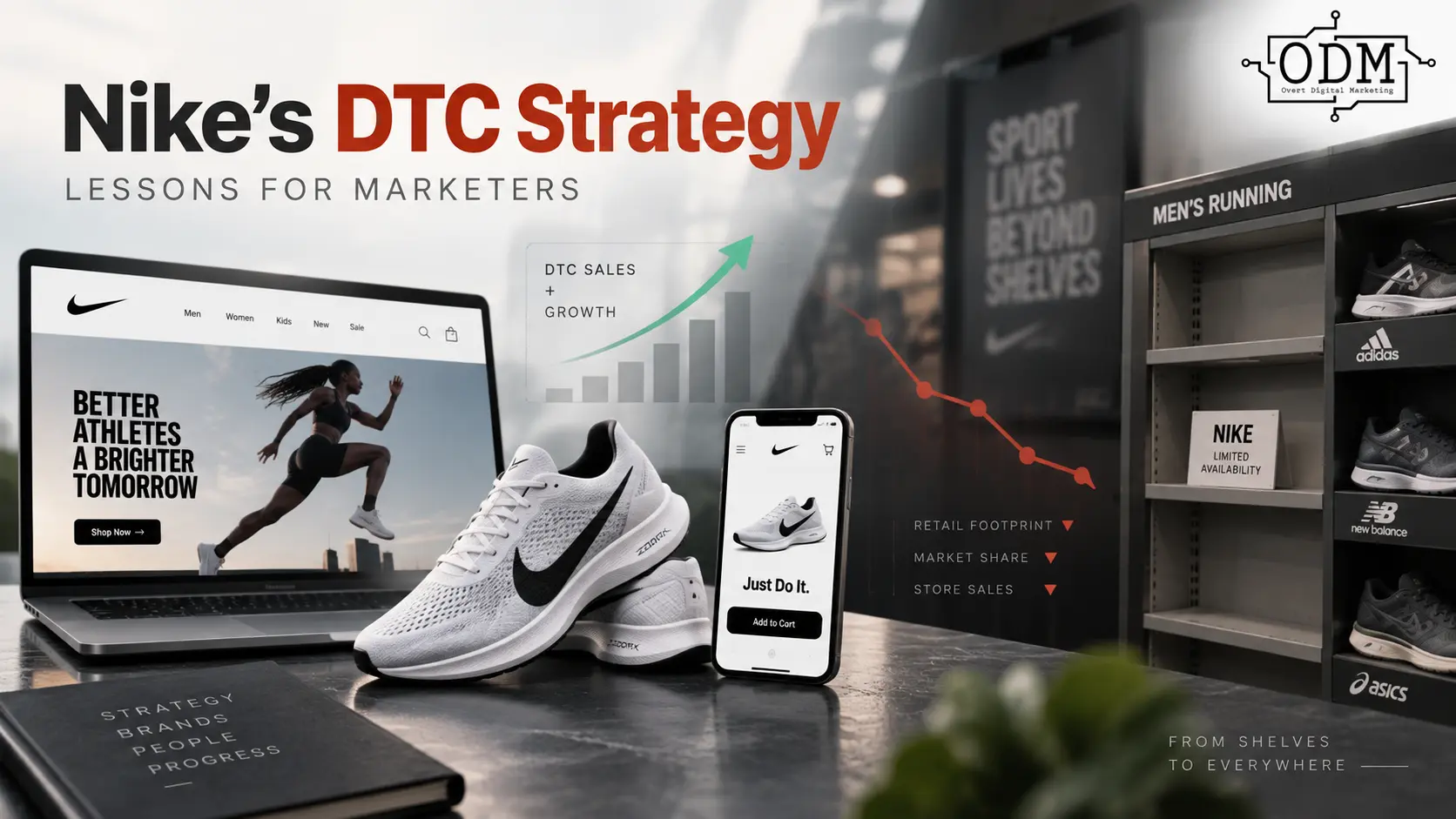
Nike’s decline over the past several years is one of the clearest examples of what can happen when a business becomes too concentrated around one route to market.
In 2020, Nike accelerated its shift towards a direct-to-consumer model, placing greater emphasis on Nike.com, its apps and Nike-owned stores while becoming more selective about wholesale distribution. The strategy promised higher margins, greater control over the customer experience and more direct access to customer data.
On paper, the logic was compelling.
The problem was that retailers were doing more than simply selling Nike products. They were also providing distribution, customer discovery, physical visibility and an environment where shoppers compared Nike against competing brands. As Nike reduced some of that exposure, competitors gained more opportunities to reach those customers.
The financial picture today is significant. Nike reported US$46.4 billion in revenue for fiscal 2026, but Nike Direct revenue fell 6% to US$17.7 billion and Nike Brand Digital fell 12%. At the same time, wholesale revenue increased 6% to US$27.5 billion.
Nike’s wider challenges have also been reflected in its market value. Reuters reported in September 2026 that Nike was being removed from the S&P 100 after 18 years, following an approximately 80% decline in market value over five years. The decline cannot be attributed to the direct-to-consumer strategy alone. Nike has also faced slowing sales, product innovation challenges, changing consumer preferences and increasing competition.
But the direct-to-consumer shift provides an important marketing lesson.
Nike wanted greater ownership of the customer relationship. In doing so, it also reduced some of the places where customers could discover, compare and buy the brand.
That same risk exists in digital marketing.
A business can become overly dependent on Google Ads because it generates the strongest immediate return. It can rely too heavily on Meta because it produces cheap leads. It can focus almost entirely on SEO because organic traffic appears more cost-effective. Or it can assume that ranking well on Google means emerging discovery channels such as AI search and answer engines do not yet matter.
The individual channel may be performing well, but the broader customer acquisition system can still become weaker.
The lesson from Nike is therefore not that direct-to-consumer marketing is a bad strategy. It is that businesses should understand the role every channel plays in creating demand, generating discovery and converting customers before deciding that one channel can replace another.
As customer discovery becomes increasingly fragmented across search engines, social platforms, marketplaces and AI tools such as ChatGPT and Gemini, that lesson is becoming even more relevant.
What Was Nike’s Consumer Direct Acceleration Strategy?
Nike introduced its Consumer Direct Acceleration strategy in 2020 with the aim of creating a more direct relationship with customers and accelerating growth through digital channels.
The strategy placed greater emphasis on Nike.com, the Nike app ecosystem and Nike-owned retail stores, while the company became more selective about its wholesale partnerships. The broader objective was to increase the proportion of sales generated through channels Nike controlled directly.
From a business perspective, the appeal was clear.
Selling directly to customers can improve margins by reducing reliance on third-party retailers. It also gives a brand greater control over pricing, merchandising, customer data, loyalty programs and the overall buying experience.
For Nike, digital growth was also becoming increasingly important. Ecommerce adoption was accelerating, mobile shopping was growing, and the company had invested heavily in its apps, membership program and direct customer relationships.
The strategy was therefore not simply about cutting wholesale distribution. It was about repositioning Nike around a more digitally led, data-driven and direct relationship with consumers.
However, becoming more selective with wholesale also changed how customers encountered Nike products in the market.
Retail partners such as Foot Locker, department stores and other multi-brand retailers were not only places where Nike products were sold. They were also important discovery environments where customers could browse, compare brands and encounter products they may not have actively searched for.
That distinction would become increasingly important.
The direct-to-consumer strategy gave Nike greater control over the channels it owned, but it also increased the importance of those channels continuing to generate enough customer discovery, demand and sales to compensate for the distribution being reduced elsewhere.
Why Going Direct Looked Like the Right Strategy
Nike’s shift towards direct-to-consumer was not an obviously bad decision when it was made.
In fact, many of the strategic arguments behind it were strong.
Selling more products directly through Nike-owned channels gave the company greater control over the customer relationship. Nike could manage the brand experience, pricing, merchandising, product launches and loyalty activity without relying as heavily on third-party retailers.
There was also a financial incentive.
Direct sales can produce stronger margins because the brand captures more of the retail value itself rather than sharing that margin with wholesale partners. For a company of Nike’s scale, even relatively small improvements in margin can have a significant impact.
Customer data was another major advantage.
When shoppers buy directly through Nike.com, Nike apps or Nike-owned stores, the company gains more first-party information about who is buying, what they are interested in and how they interact with the brand. That data can then support personalisation, loyalty, product development and future marketing.
The timing also made the strategy appear even more compelling.
In 2020, ecommerce adoption accelerated rapidly as consumers became more comfortable researching and purchasing products online. Digital channels were growing in importance, and businesses across many industries were investing heavily in direct customer relationships.
For Nike, the opportunity appeared to be clear: build stronger owned digital channels, reduce dependence on intermediaries and create a more direct relationship with millions of customers.
The problem was not the logic behind direct-to-consumer itself.
The risk emerged when greater efficiency and control in one part of the business began to reduce reach and discovery elsewhere.
That is an important distinction for any marketing strategy.
A channel can look more profitable when measured in isolation while another channel appears less efficient because part of its value is harder to attribute directly. But if the second channel is helping customers discover the brand, compare products or generate demand that eventually converts elsewhere, reducing it can have consequences that do not immediately appear in channel-level reporting.
Nike’s strategy therefore provides an important example of why businesses should be careful when optimising individual channels without understanding how the entire customer journey works together.
What Nike Gave Up When It Reduced Wholesale Distribution
When Nike reduced its reliance on wholesale partners, it was not simply giving up lower-margin sales.
It was also reducing some of the places where customers discovered, compared and interacted with the brand.
Retailers such as Foot Locker and other multi-brand stores played an important role in Nike’s customer journey. Shoppers could walk into a store intending to browse rather than buy a specific Nike product, compare different brands side by side, try products on and discover new styles they may not have actively searched for online.
That exposure has value even when the final transaction does not happen immediately.
Wholesale partners also provided Nike with physical shelf space, local distribution and access to customers who may not have been visiting Nike.com, downloading the Nike app or shopping in a Nike-owned store.
As Nike reduced some of that presence, competitors had more opportunities to occupy the same retail environment.
Brands such as On and Hoka were expanding aggressively during the same period, particularly in performance footwear. Increased visibility in multi-brand retail environments gave those competitors more opportunities to be discovered by customers who might previously have encountered Nike more prominently.
The strategic issue was therefore broader than lost wholesale revenue.
Nike was reducing one of the environments in which demand could be created.
This distinction is critical in marketing.
A sales channel can contribute value before the transaction takes place. It can introduce a brand, create familiarity, influence consideration and make future purchases more likely, even if another channel eventually receives credit for the conversion.
The same principle applies online.
A customer may first discover a business through Meta, later research it through Google, read organic content, encounter the brand again through remarketing and eventually convert through a branded search.
If the business evaluates each channel only by the transactions directly attributed to it, the discovery channel can appear less valuable than it really is.
Nike’s wholesale strategy provides a useful example of this problem at scale.
The company gained greater control over more of its direct customer relationships, but reducing third-party distribution also reduced some of the physical environments where new customers encountered and evaluated the brand.
That is the trade-off businesses need to understand before deciding that a channel is expendable simply because another one appears more profitable.
The Numbers: What Happened to Nike Direct and Wholesale?
Nike’s financial results show a clear shift in the performance of its direct and wholesale channels.
For fiscal 2026, Nike reported total revenue of US$46.4 billion, which was flat on a reported basis and down 2% on a currency-neutral basis.
Within that result, however, the channel performance looked very different.
Nike Direct revenue fell 6% to US$17.7 billion, while Nike Brand Digital declined 12% and Nike-owned store revenue fell 4%.
Wholesale moved in the opposite direction.
Nike reported wholesale revenue of US$27.5 billion for fiscal 2026, an increase of 6% on a reported basis and 4% on a currency-neutral basis.
| Metric | Fiscal 2026 result |
| NIKE, Inc. revenue | US$46.4 billion |
| Nike Direct | US$17.7 billion, down 6% |
| Nike Brand Digital | Down 12% |
| Nike-owned stores | Down 4% |
| Wholesale | US$27.5 billion, up 6% |
Those numbers do not prove that Nike’s DTC strategy caused its broader business problems. Nike has been dealing with a much wider set of challenges involving product innovation, competitive pressure, regional performance and changing consumer demand.
But they do highlight an important reversal.
The part of the business that Nike had spent years prioritising, its direct relationship with customers, was declining while wholesale was growing again.
The contrast was also visible in Nike’s fourth quarter results. Wholesale revenue increased 4% to US$6.6 billion, while Nike Direct fell 7% to US$4.1 billion. Nike Brand Digital was again down 12% during the quarter.
At the same time, Nike’s broader market performance illustrates just how significant the company’s challenges have become. Reuters reported in September 2026 that Nike was being removed from the S&P 100 after 18 years, following an approximately 80% decline in market value over the previous five years. Reuters attributed that wider decline to slowing sales, innovation struggles and increasing competition rather than any single strategic decision.
That distinction matters.
The lesson is not that wholesale suddenly became better than direct-to-consumer.
It is that Nike’s financial performance increasingly demonstrated why both channels served different purposes.
Direct channels gave Nike control over the customer relationship, data and brand experience. Wholesale gave Nike scale, distribution and access to customers shopping in environments Nike did not control.
The numbers reinforce a broader marketing principle: a channel can become strategically more valuable than its standalone margin or attribution initially suggests.
When businesses concentrate too heavily on whichever channel appears most efficient today, they risk weakening the channels that are creating discovery, reach and future demand.
Why Did Nike’s Direct-to-Consumer Strategy Struggle?
Nike’s direct-to-consumer strategy struggled because reducing wholesale exposure also reduced distribution, retail visibility and some of the environments where customers discovered and compared the brand. At the same time, Nike faced stronger competition, product and innovation challenges, weaker digital performance and changing consumer demand.
The important point is that direct-to-consumer itself was not the problem.
Nike’s owned channels gave the business greater control over customer data, pricing, brand experience and margins. Those advantages remained valuable. The issue was that Nike had become more dependent on those channels while reducing the role of wholesale partners that were contributing something different.
Retailers helped Nike reach customers who were not necessarily beginning their shopping journey with Nike.
A shopper entering a Foot Locker or another multi-brand retailer might compare Nike with Adidas, Hoka, On or other alternatives. That environment created discovery and consideration even when the customer had not specifically set out to buy Nike.
When Nike reduced some of that distribution, it also reduced some of those discovery opportunities.
At the same time, competitors were becoming increasingly visible. Hoka and On, in particular, gained momentum in performance footwear and were able to occupy more attention within the same retail environments where Nike had historically been dominant.
Nike also faced challenges within its own direct channels.
Nike Brand Digital revenue declined significantly in fiscal 2025 and again in fiscal 2026, demonstrating that simply moving more of the customer relationship into owned digital platforms did not guarantee continuing growth.
Product strategy also played a role. Nike has acknowledged the need to rebuild its product pipeline and increase innovation, while excessive reliance on established franchises created challenges around product freshness and customer excitement.
There were therefore multiple pressures occurring at the same time.
Nike had reduced some external distribution, its digital business was weakening, competitors were gaining momentum and the company was working through product and innovation challenges.
That combination made the risks of channel concentration more visible.
The broader lesson for businesses is that moving customers into channels you control can be valuable, but owned channels still need external sources of discovery and demand.
A business can have an excellent website, strong email database and sophisticated CRM system, but those assets become less valuable if fewer new customers are discovering the business in the first place.
The same principle applies to digital marketing.
Google Ads, Meta Ads, SEO, AEO, marketplaces, referrals and other channels can each contribute differently to customer acquisition. Removing one because another appears more efficient can weaken the overall system if the channel being removed was creating demand that converted somewhere else.
Nike’s experience illustrates why channel strategy should be evaluated across the entire customer journey rather than judged purely by which channel produces the highest short-term return.
Lesson 1: Customer Ownership Is Not the Same as Customer Access
One of the most important lessons from Nike’s direct-to-consumer strategy is that owning the customer relationship is not the same as having access to the customer.
Nike wanted more direct relationships through Nike.com, its apps and Nike-owned stores. That gave the company more control over customer data, pricing, loyalty, personalisation and the overall brand experience.
But customers do not necessarily begin their buying journey inside the channels a brand owns.
They discover products while browsing retailers. They compare brands side by side. They ask friends for recommendations. They search Google, watch YouTube, use social media, read reviews and increasingly ask AI tools such as ChatGPT and Gemini for advice.
That distinction matters because businesses can become too focused on where they want the customer to convert rather than where the customer actually discovers them.
Nike’s wholesale partners gave the brand access to shoppers who may not have visited Nike.com or opened a Nike app. Those customers could still encounter the product, try it, compare it with competitors and form an opinion about the brand.
In digital marketing, the same issue appears when businesses become overly dependent on owned channels.
A company may have an excellent website, a valuable email database and strong customer retention. But those assets do not automatically create new demand. New customers still need a reason and a pathway to discover the business.
That discovery might come through Google Ads.
It might come through an organic search result.
It might come from a Meta campaign that creates awareness before the customer is ready to buy.
It might come from an AI-generated answer that introduces the business while someone is researching a problem.
It might come from a marketplace, review platform, referral or another third-party environment.
The channel where the customer finally converts is therefore only one part of the journey.
For businesses, the strategic objective should not be to force every customer into a single owned channel as early as possible. It should be to understand how customers actually move from discovery to consideration and finally to conversion.
Owning the relationship becomes valuable once the customer arrives.
Maintaining enough access points to keep new customers arriving is what makes that relationship possible in the first place.
Lesson 2: Never Judge a Marketing Channel Only by Last-Click Revenue
One of the easiest mistakes in marketing is to judge a channel only by the revenue directly attributed to it.
That can make some channels look far more valuable than they really are, while making others appear less important because their contribution happens earlier in the customer journey.
Nike’s wholesale partners illustrate this clearly.
A wholesale retailer did not only generate the transaction that occurred in-store. It also gave Nike visibility, created product discovery, allowed customers to compare alternatives and helped reinforce the brand in the market.
If Nike evaluated wholesale purely on the margin generated by the final sale, some of that wider value could be easy to underestimate.
Digital marketing works in much the same way.
A customer may first see a Meta ad, later search for the business on Google, visit the website through an organic result, return through remarketing and eventually convert after clicking a branded Google Ads campaign.
Last-click attribution may give most or all of the credit to the final Google Ads interaction.
But that does not mean Google Ads created the customer journey.
The Meta campaign may have introduced the brand. SEO may have helped establish credibility. Remarketing may have kept the business visible. The branded search campaign may simply have captured demand that had already been created elsewhere.
This is why channel-level performance can be misleading when it is viewed without context.
The channel showing the strongest return on ad spend may be excellent at capturing existing demand, while another channel with a weaker direct return may be responsible for creating that demand in the first place.
The danger comes when businesses cut the second channel because it appears less efficient.
Initially, the overall numbers may even improve. Advertising spend falls, the remaining channels report stronger returns and cost per acquisition may look better.
Over time, however, the pool of new customers entering the funnel can begin to shrink.
Fewer people discover the brand.
Branded search demand can weaken.
Remarketing audiences become smaller.
The channels that once appeared highly efficient have less demand available to capture.
Nike’s experience provides a useful reminder that a channel’s value should be measured by the role it plays across the wider customer journey, not simply by whether it receives credit for the final conversion.
For businesses, that means looking beyond last-click revenue and asking a more important question:
What would happen to total demand and revenue if this channel disappeared?
Lesson 3: Efficiency Can Eventually Starve Growth
One of the most dangerous outcomes in marketing is when short-term efficiency begins to look like long-term strategy.
A channel that delivers the lowest cost per acquisition or the highest return on ad spend can quickly become the favourite. Budgets move towards it. Other channels are reduced. Reporting improves.
But efficiency is not the same as growth.
Nike’s direct-to-consumer strategy illustrates this tension. Direct channels offered better control, stronger customer data and the potential for higher margins. On a transaction-by-transaction basis, that could make DTC look more attractive than wholesale.
The problem is that wholesale was also helping create reach and demand.
When a business focuses too heavily on the channel that converts demand most efficiently, it can gradually reduce investment in the channels that create that demand in the first place.
This happens frequently in digital marketing.
Branded Google Ads can produce an excellent return because the customer already knows the business and is actively searching for it.
Retargeting can look highly efficient because it focuses on people who have already shown interest.
Email can generate low-cost sales because the audience is already familiar with the brand.
None of those channels is inherently problematic. The issue arises when the business starts assuming they are responsible for creating all of the demand they convert.
Someone still has to discover the brand.
Someone still has to become interested.
Someone still has to enter the funnel.
That earlier demand may be created through Meta advertising, broader Google campaigns, SEO content, PR, YouTube, referrals, marketplaces, AEO, AI discovery or other channels.
If investment in those areas is continually reduced because their direct return appears weaker, the business can eventually become extremely efficient at converting a shrinking pool of customers.
This is the difference between demand creation and demand capture.
Demand creation introduces customers to the business and gives them a reason to consider it.
Demand capture converts customers who are already looking for a solution, product or brand.
Strong marketing needs both.
The lesson from Nike is that optimising for control, margin or channel-level efficiency can create unintended consequences if it reduces the overall number of customers entering the buying journey.
The objective should therefore not be to concentrate all investment in whichever channel reports the strongest short-term return.
It should be to build a marketing system that creates enough new demand while capturing that demand efficiently.
A business that optimises only for efficiency can eventually discover that it has become very good at converting customers it is no longer creating enough of.
Lesson 4: Competitors Fill the Space You Leave Behind
One of the clearest risks in reducing a marketing or distribution channel is that the space you leave behind does not remain empty.
When Nike pulled back from parts of wholesale distribution, competitors gained more opportunities to be seen in the same environments.
Brands such as Hoka and On were expanding rapidly in performance footwear and were increasingly visible in multi-brand retail stores. That gave shoppers more opportunities to discover, compare and consider alternatives at the point of purchase.
This is an important strategic lesson because visibility is competitive.
When a business reduces its presence in a channel, competitors do not usually reduce theirs at the same time.
The same principle applies across digital marketing.
If a business stops investing in SEO, competing websites continue publishing, building authority and gaining search visibility.
If it reduces Google Ads, competitors can occupy more of the paid search results when customers are actively looking for a solution.
If it pulls back from Meta advertising, competing brands may continue building awareness and consideration while its own visibility declines.
If it ignores AEO and AI search, competitors have more opportunity to become the brands, sources and answers surfaced when customers ask questions through Google AI Overviews, ChatGPT or Gemini.
This does not mean businesses should remain active in every channel indefinitely.
The point is that leaving a channel should be a strategic decision, not simply a response to weaker short-term attribution.
Before reducing investment, businesses should understand what role that channel plays in customer discovery, how competitors are using it and whether another channel can realistically replace the lost visibility.
The cost of leaving a channel is therefore not limited to the traffic or conversions that disappear immediately.
It can also include the market share, brand visibility and customer attention that competitors gain in your absence.
Nike’s experience reinforces an important marketing principle:
Visibility surrendered is often visibility transferred.
For businesses, that means channel decisions should always be made with the competitive environment in mind, not only the performance numbers inside the platform.
Lesson 5: Marketing Diversification Is Risk Management
A diversified marketing strategy is not about being active on every available platform.
It is about avoiding unnecessary dependence on any single source of customers, traffic or demand.
Nike’s shift towards direct-to-consumer increased its reliance on channels it controlled directly. That offered advantages in margin, customer data and brand experience, but it also increased the importance of those channels continuing to perform strongly enough to replace the reach and discovery provided elsewhere.
When too much growth depends on one channel or one type of customer journey, the business becomes more exposed if conditions change.
Digital marketing carries the same risk.
Google Ads can become more expensive.
Meta targeting and attribution can change.
Search algorithms can reduce organic visibility.
Privacy changes can affect tracking and audience targeting.
AI platforms can change how people discover products and services.
A channel that performs exceptionally well today may still become less effective, more expensive or more competitive over time.
This is why diversification should be viewed as a form of marketing risk management.
The objective is not to spread budget evenly across every channel. It is to build multiple effective pathways through which customers can discover, evaluate and buy from the business.
For one company, that might mean Google Ads, SEO and email.
For another, it could mean Meta Ads, Google Shopping, marketplaces and organic search.
Increasingly, it may also include AEO and GEO as customers use AI-powered search and conversational tools to research products, compare services and make decisions.
The right channel mix will vary by business.
What matters is understanding how much of total customer acquisition depends on each channel and whether another part of the marketing ecosystem could realistically replace it if performance changed.
A business that receives the majority of its leads from one source may appear highly efficient, but it is also carrying concentration risk.
Nike’s experience shows why that matters.
When a business reduces one major route to the customer, the remaining channels need to do more work. If they cannot replace the lost reach, discovery or demand, the impact can extend well beyond the performance of the individual channel that was reduced.
The strongest marketing strategies therefore balance efficiency with resilience.
They capture demand where performance is strongest while maintaining enough diversity to keep generating new customers when platforms, competitors and consumer behaviour change.
Do Not Replace Channels. Understand the Role Each One Plays
One of the biggest mistakes businesses can make is treating marketing channels as interchangeable.
They are not.
Different channels contribute at different stages of the customer journey, and the channel that creates demand is not always the same one that captures it.
Google Ads can be highly effective at reaching customers who are already searching for a product or service.
Meta Ads can introduce a business to people who were not yet actively looking.
SEO can build sustained organic visibility and attract customers researching a problem over time.
Email and CRM can nurture existing prospects and customers.
The website and conversion experience then determine how effectively that demand turns into enquiries or sales.
The mistake is assuming that because one channel appears to perform better in isolation, it can replace the others.
A business might look at Google Ads and see a stronger return than Meta, then move most of its budget into search. In the short term, performance may improve because Google is capturing high-intent customers.
But if Meta was helping create awareness and increasing the number of people later searching for the brand, cutting it too aggressively can eventually reduce the demand Google has available to capture.
The same issue can occur with SEO.
Organic traffic may appear inexpensive compared with paid media, but relying heavily on search rankings creates exposure to algorithm changes, increasing competition and shifts in how customers research.
Conversely, relying entirely on paid media can leave a business vulnerable to increasing acquisition costs and platform changes.
The objective is therefore not to identify one winning channel.
It is to understand what role each channel plays in the wider acquisition system.
A useful way to think about channel strategy is:
| Channel | Typical role |
| Google Ads | Capture existing demand |
| Meta Ads | Build awareness and create demand |
| SEO | Generate sustained organic discovery and traffic |
| Email and CRM | Nurture prospects and retain customers |
| Website and CRO | Convert demand into enquiries or sales |
These roles are not absolute. Google Ads can create demand, Meta can generate direct conversions and SEO can influence customers throughout the buying journey.
The framework simply highlights why comparing channels solely on the final conversion can lead to poor decisions.
Nike’s experience shows what can happen when one route to the customer is prioritised too heavily at the expense of another.
The better approach is not to continually replace channels.
It is to understand how they work together, where customers are discovering the business and which parts of the system are creating, capturing and converting demand.
That is how businesses build marketing strategies that are both efficient and resilient.
What Should Businesses Learn From Nike?
The main lesson from Nike’s direct-to-consumer strategy is that businesses should not become overly dependent on one route to market simply because it appears more efficient or more profitable in isolation.
Nike’s experience shows why channel decisions need to be made across the entire customer journey.
A business should understand where customers first discover the brand, which channels build awareness and consideration, which channels capture existing demand and which parts of the journey ultimately convert that demand into revenue.
That means asking broader questions before reducing investment in any channel.
Is this channel creating demand that converts somewhere else?
Does it help customers discover the business before they are ready to buy?
Would competitors gain visibility if the business reduced its presence?
Could another channel genuinely replace the reach, demand or customer access being lost?
How dependent is total growth on one platform or source of customers?
These questions matter because marketing performance is interconnected.
A channel with weaker direct attribution can still be strategically valuable if it introduces customers who later convert elsewhere. Likewise, a high-performing channel may be benefiting from demand created by activity that appears less efficient in reporting.
The goal should therefore not be to find the single best marketing channel.
It should be to build a system where the right channels work together to create, capture and convert demand.
Nike’s strategy also shows why businesses should be careful when following broad industry trends without considering how their own customers behave.
Direct-to-consumer was attractive for good reasons. Greater control, better customer data and stronger margins all made sense strategically.
But customer behaviour does not always follow the strategy a business would prefer.
If customers still want to shop through retailers, compare brands in-store or discover products through third-party environments, removing those pathways can create friction rather than efficiency.
The same principle applies to digital marketing.
The strongest strategy is the one built around how customers actually research, compare and buy, not around which channel happens to look best on a dashboard today.
How Overt Digital Marketing Approaches Channel Strategy
At Overt Digital Marketing, we do not start with the assumption that one channel should dominate simply because it is currently producing the strongest headline result.
We start by looking at how customers actually discover, research and choose a business.
That means understanding where demand is being created, where it is being captured, what influences the final decision and how each channel contributes to the broader customer journey.
For some businesses, Google Ads may be the strongest channel for capturing high-intent demand.
For others, Meta Ads may play a larger role in creating awareness before customers begin actively searching.
SEO can build sustained visibility and authority over time, while email, remarketing and CRO can help convert and retain demand that has already been created.
The important point is that these channels should not be assessed in isolation.
A strong Google Ads campaign can look highly efficient because it is capturing demand that already exists. But if the business cuts the channels responsible for creating that demand, search performance can eventually weaken.
Likewise, a Meta campaign may appear less efficient on a last-click basis while still playing an important role in introducing customers who later convert through search or another channel.
Our approach is therefore to look at the marketing ecosystem rather than simply the platform dashboard.
That means evaluating commercial outcomes such as lead quality, revenue, customer acquisition cost, conversion rate, return on advertising spend and profitability, while also understanding how channels influence one another.
Nike’s experience is a useful reminder of why that matters.
The objective is not to make one channel win.
It is to build a marketing system that creates demand, captures it efficiently and converts it into commercially meaningful growth without becoming dangerously dependent on a single source of customers.
Frequently Asked Questions
Why did Nike’s direct-to-consumer strategy struggle?
Nike’s direct-to-consumer strategy struggled because reducing wholesale exposure also reduced distribution, retail visibility and some of the environments where customers discovered and compared the brand. At the same time, Nike faced stronger competition, weaker digital performance, product challenges and changing consumer demand.
Did Nike’s DTC strategy cause its stock decline?
No single decision explains Nike’s broader stock and market value decline. The DTC strategy was one contributing strategic issue, but Nike has also faced slowing sales, product innovation challenges, increasing competition, regional weakness and other operating pressures.
Why is Nike rebuilding wholesale relationships?
Wholesale retailers provide more than transactions. They give Nike distribution, shelf visibility, customer discovery and access to shoppers who may not begin their journey through Nike-owned channels. Rebuilding those relationships helps restore reach while Nike continues to develop its direct channels.
What can businesses learn from Nike’s marketing strategy?
The main lesson is to avoid becoming too dependent on one route to market. Businesses should understand which channels create demand, which capture it and how they work together before reducing investment based only on short-term efficiency or last-click attribution.
Why is relying on one marketing channel risky?
Relying heavily on one channel creates concentration risk. Advertising costs can change, algorithms can shift, competitors can become more aggressive and customer behaviour can move elsewhere. A diversified strategy gives businesses multiple ways to generate and convert demand.
What is the difference between demand creation and demand capture?
Demand creation introduces customers to a business and gives them a reason to consider it. Demand capture reaches customers who are already actively looking for a product, service or solution. Strong marketing strategies usually need both.
Is the highest-ROAS marketing channel always the most valuable?
Not necessarily. A channel can report a high return because it is capturing demand created elsewhere. Another channel with a lower direct return may still be responsible for generating awareness, discovery or consideration that later converts through the higher-ROAS channel.
Should businesses use multiple marketing channels?
Most businesses benefit from having more than one effective route to customers, but that does not mean being active everywhere. The right mix depends on customer behaviour, margins, demand, competition and the role each channel plays across the buying journey.



Related Posts