
Online shopping has followed the same pattern for years. Customers browse a website, use filters, compare options and eventually add something to a cart. That model is now being challenged by a new approach known as conversational commerce, where buying decisions happen through natural dialogue rather than menus and search boxes. The partnership between ChatGPT and Shopify signals that this shift is no longer theoretical but rapidly becoming part of everyday digital marketing.
Instead of scrolling through pages of products, customers can now describe what they want in plain language and receive tailored recommendations. This mirrors the experience of walking into a store and speaking with a knowledgeable salesperson. The difference is that conversational commerce happens at scale, powered by artificial intelligence and connected directly to ecommerce platforms.
This evolution also ties closely with the arrival of chatgpt ads. As people ask questions and explore options inside AI tools, sponsored placements can appear at the exact moment of high intent. The line between advice, discovery and purchasing becomes much shorter. For businesses using Shopify, this creates a new pathway to reach customers before they even visit a traditional website.
The result is a fundamental change in how brands need to think about digital strategy. Success will depend less on pushing traffic to static pages and more on participating in helpful conversations. This article explores what conversational commerce means, how the ChatGPT and Shopify partnership fits into the picture and why chatgpt ads are likely to become a key part of the modern customer journey.
What the ChatGPT and Shopify Partnership Means
The collaboration between ChatGPT and Shopify is more than a simple integration. It represents a new way for ecommerce businesses to connect with customers at the moment they are seeking guidance. Instead of relying solely on search results or website navigation, merchants can have their products surfaced inside natural conversations. This is the core idea behind conversational commerce.
For Shopify store owners, the partnership opens the door to product discovery that happens before a customer ever lands on a category page. When someone asks for advice on a gift, a piece of equipment, or a style of clothing, the AI can draw from merchant data to present relevant options. The process feels closer to speaking with a helpful assistant than browsing an online catalogue.
This approach also shortens the traditional buying funnel. In the past a customer might search on Google, click through several websites, read reviews and compare prices before making a decision. Conversational commerce allows many of those steps to occur inside a single dialogue. Questions about features, sizing, or delivery can be answered immediately, reducing friction and hesitation.
The partnership is significant because Shopify powers millions of online stores worldwide. By connecting those merchants with ChatGPT, a vast range of products can become part of AI driven conversations. When combined with chatgpt ads, businesses have the opportunity to appear both organically through helpful suggestions and commercially through sponsored placements.
For digital marketers this signals a shift in priorities. Product feeds, descriptions and customer information will become just as important as keyword lists. Brands that prepare their Shopify data for conversational commerce will be better positioned to benefit from this new ecosystem as it continues to grow.
The Rise of Conversational Commerce
The idea behind conversational commerce is simple. People prefer to explain what they need rather than navigate complicated menus. In a physical store, customers naturally ask questions such as which option is best, what fits their budget, or how a product compares with another. Online shopping has rarely offered that same experience, forcing users to translate their needs into filters and search terms.
Artificial intelligence is changing this behaviour. Tools like ChatGPT allow customers to describe situations in their own words and receive tailored responses instantly. Instead of typing short keywords, they can say they need a laptop for school, a present for a five year old, or a solution for a leaking roof. Conversational commerce turns those descriptions into practical recommendations.
This shift also changes how trust is built. Traditional ecommerce relies on reviews, star ratings and product pages to convince a buyer. In a conversational setting, trust develops through helpful dialogue. The AI explains options, answers follow up questions and guides the user toward a decision in a way that feels personal and supportive.
The growth of conversational commerce is not limited to retail. Service businesses are seeing the same trend. Customers ask for advice about courses, insurance, or home improvements and expect clear explanations rather than sales pitches. The businesses that can participate in these conversations will capture attention earlier than competitors waiting for a website visit.
As this behaviour becomes mainstream, advertising must adapt as well. Chatgpt ads are designed to fit naturally into these dialogues, appearing when there is genuine intent to explore a product or service. Rather than interrupting a user, the ad becomes part of the conversational commerce experience, offering a logical next step when someone is ready to act.
Where ChatGPT Ads Fit Into This Model
Conversational commerce creates a new environment where discovery, advice and purchasing happen in the same place. Within that environment, chatgpt ads are expected to play the role of a helpful bridge between information and action. Instead of pushing promotions at random, ads can appear when a conversation clearly shows commercial intent.
For example, if a user is discussing the best type of running shoes for flat feet, the AI may provide general guidance about support and comfort. At that moment a chatgpt ad from a sporting retailer could appear beneath the response, offering a relevant product range. The advertisement does not influence the advice but complements it with a practical option to explore further. This is conversational commerce in action.
The strength of this model lies in timing. Traditional digital advertising often tries to guess when someone might be interested based on past behaviour. In a conversational setting, intent is visible in real time through the questions being asked. Chatgpt ads can therefore be shown at the precise point when a customer is open to considering a brand.
This approach also changes the creative requirements for advertisers. Long promotional copy and heavy visuals become less important than clear, concise messaging that matches the conversation. Brands will need to think about the problems they solve rather than the keywords they target. Conversational commerce rewards relevance over volume.
For Shopify merchants, the connection is particularly powerful. A chatgpt ad can lead directly to a product page or collection that aligns with the dialogue. The journey from question to checkout becomes shorter and more natural, reducing the steps that typically cause users to abandon a purchase.
As more businesses participate, chatgpt ads are likely to become one of the main commercial engines
The New Customer Journey
Conversational commerce reshapes the path a customer follows before making a purchase. The traditional journey began with a search query, followed by multiple website visits, comparisons and reviews. In the new model much of this exploration happens inside a single conversation, guided step by step through natural language.
A typical journey might begin with a simple question such as asking for gift ideas within a certain budget. The AI responds with suggestions and asks clarifying questions about preferences. At this point a relevant chatgpt ad may appear, presenting products from a Shopify store that match the discussion. The customer can then click through to a focused landing page instead of navigating a large catalogue.
Once on the website, the experience needs to continue the conversational tone. Product pages that clearly answer common questions and highlight benefits will perform better than pages built only for search engines. Conversational commerce rewards businesses that think about what a customer wants to know at each stage rather than what keywords to rank for.
Follow up questions can occur before or after the click. A user might return to the conversation to ask about delivery times, warranties, or alternatives. Each interaction builds confidence and moves the customer closer to a decision. The boundary between research and purchasing becomes fluid rather than separated into different channels.
For marketers this means the funnel is shorter but more dynamic. Success will depend on aligning ad messaging, product information and website experience so they feel like one continuous dialogue. Businesses that understand this new journey will gain an advantage as conversational commerce becomes a mainstream way to shop.
Opportunities for Ecommerce Businesses
For online retailers, conversational commerce opens possibilities that did not exist within traditional search driven marketing. Instead of waiting for customers to find the right category or keyword, businesses can appear directly inside conversations where needs are being expressed in real time. This allows merchants to reach buyers earlier in the decision process.
Shopify stores are particularly well positioned. With structured product data already in place, these businesses can present relevant items when a user asks for advice. A clothing retailer can showcase outfits based on style preferences, while a homewares store can suggest items that match a budget or theme. When supported by chatgpt ads, this discovery becomes both organic and commercial.
Another opportunity lies in differentiation. Many ecommerce sites offer similar products and compete mainly on price. Conversational commerce shifts the focus to guidance and expertise. Brands that explain benefits clearly, provide honest comparisons and answer common concerns will stand out more than those relying only on discounts.
Customer acquisition costs could also change. Traffic from search and social platforms has become increasingly expensive. If chatgpt ads deliver highly qualified visitors who are already engaged in a conversation about a product, the return on investment may be stronger than traditional channels. Early adopters are likely to benefit before the space becomes crowded.
Beyond direct sales, conversational commerce can improve customer loyalty. The dialogue does not end after a purchase. Users may return to ask about accessories, maintenance, or future upgrades. Businesses that continue to provide helpful information can build long term relationships rather than one off transactions.
Marketing Implications Beyond Ecommerce
Although the ChatGPT and Shopify partnership highlights retail use cases, conversational commerce is not limited to physical products. Service based businesses are likely to experience the same transformation as customers increasingly seek advice through AI conversations before contacting a company directly.
Trades, education providers, financial services and professional firms all rely on answering questions to win clients. A homeowner might ask how much a patio costs, a student may compare course pathways, or a business owner could request guidance on accounting software. In each situation a relevant chatgpt ad can connect the conversation with a trusted provider at the right moment.
This changes how service businesses think about lead generation. Instead of forcing users to complete forms before receiving information, conversational commerce allows value to be delivered first. The advertisement becomes an invitation to continue the discussion on the company website or through a consultation rather than a hard sales pitch.
Local businesses may benefit in particular. Many customers use AI tools to research options in their area before ever opening Google Maps. Appearing within those conversations can provide exposure that was previously available only through expensive search campaigns. Chatgpt ads could become a new entry point for enquiries and phone calls.
Content strategy will also need to evolve. Websites that clearly address common questions in plain language will align better with conversational commerce. Blogs, FAQs and service pages should reflect how real people describe their problems, not just how marketers phrase keywords.
For agencies and marketers, the challenge is to integrate this channel with existing campaigns. Conversational commerce should support search, social and SEO efforts rather than replace them, creating a connected ecosystem focused on genuine customer needs.
What Businesses Need to Get Right
Success with conversational commerce will depend less on technical tricks and more on the fundamentals of good marketing. Businesses that focus only on placing chatgpt ads without improving their overall experience are unlikely to see strong results. The entire journey from conversation to conversion must feel natural and helpful.
Accurate product and service information is the starting point. For Shopify merchants this means clean product feeds, clear descriptions and up to date pricing. For service businesses it means explaining offerings in straightforward language that matches the questions customers actually ask. Conversational commerce rewards clarity over marketing jargon.
Landing pages need particular attention. When a user clicks from a chatgpt ad they expect continuity with the dialogue they just had. Pages that immediately answer key concerns, highlight benefits and make the next step obvious will convert better than generic homepages. Speed and mobile friendliness are essential as many interactions will occur on phones.
Measurement is another critical area. Even though the platform prioritises privacy, businesses must be able to track enquiries, purchases and revenue on their own websites. Proper analytics setup will allow marketers to compare the performance of chatgpt ads with Google Ads and social campaigns and make informed decisions.
Finally, messaging should be built around customer problems rather than internal features. Conversational commerce is driven by real questions, so brands need to speak the same language as their audience. Those that approach this channel with empathy and useful information will gain trust and visibility.
Risks and Challenges
While conversational commerce offers exciting opportunities, it also brings new challenges that businesses must consider carefully. Jumping into chatgpt ads without a clear strategy could lead to wasted budget or inconsistent brand messaging. As with any emerging channel, early enthusiasm needs to be balanced with realistic expectations.
One risk is over reliance on a single platform. If a large portion of customer discovery happens inside AI conversations, businesses could become dependent on rules and algorithms they do not control. Diversifying across search, social, email and owned content will remain important even as conversational commerce grows.
Another challenge is maintaining brand differentiation. When recommendations are delivered through similar conversational formats, standing out requires strong value propositions and unique selling points. Companies that rely only on generic product descriptions may struggle to compete when customers can easily compare alternatives within the same dialogue.
Privacy considerations also play a role. Users expect transparency about how their interactions are used and platforms are likely to enforce strict guidelines. Businesses must ensure their tracking and data practices respect these boundaries while still providing meaningful measurement for chatgpt ads.
Finally, there is the need for organisational change. Marketing teams accustomed to managing keywords and campaigns will need to think more about customer language and problem solving. Conversational commerce requires collaboration between marketing, ecommerce and customer service to deliver a consistent experience.
Acknowledging these risks does not diminish the opportunity. Instead it highlights the importance of approaching this new channel with planning and expertise rather than quick tactics.
ODM Perspective
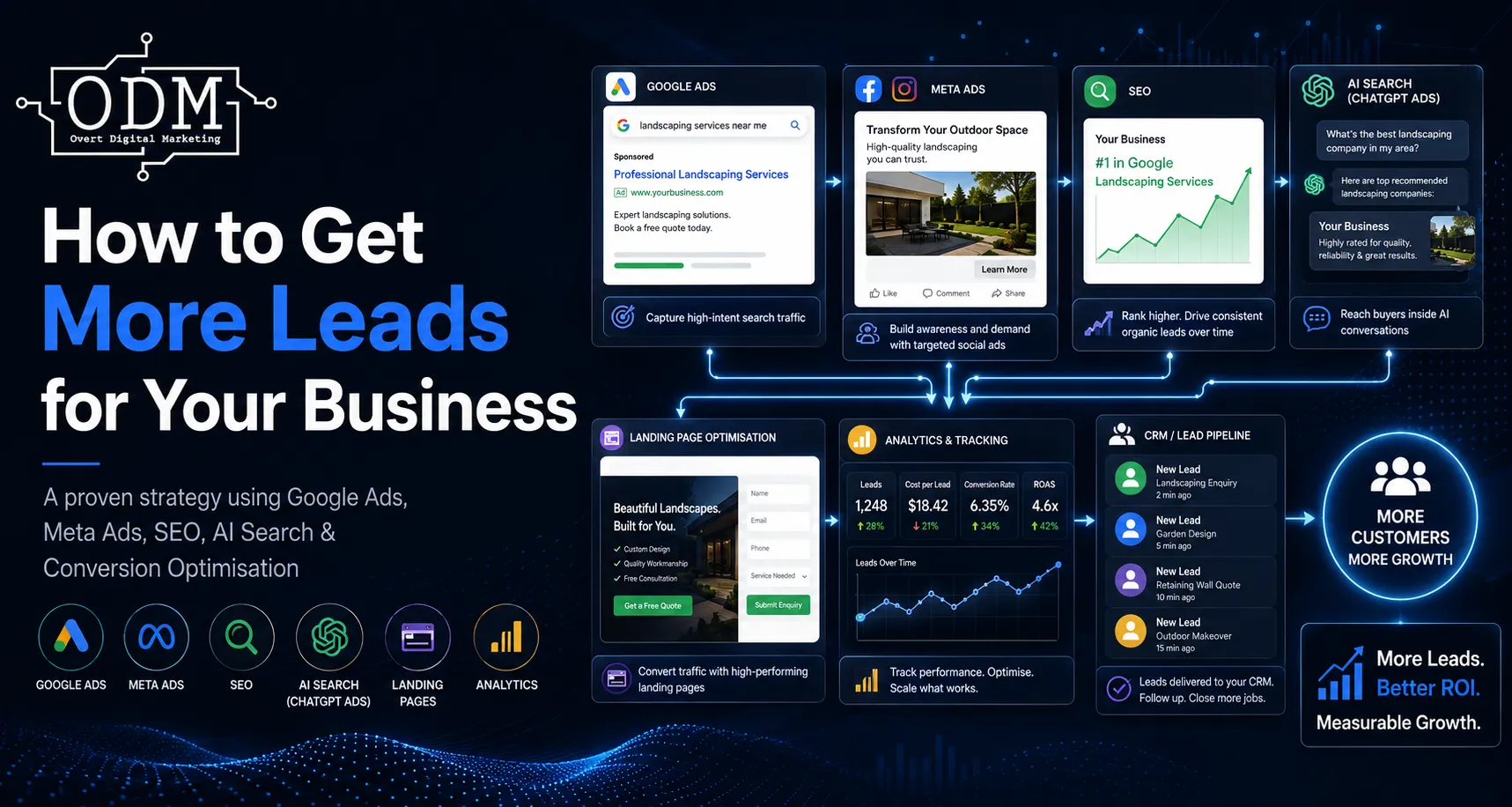
At Overt Digital Marketing (ODM) we see conversational commerce as a natural extension of the performance driven marketing we already deliver for clients. Whether the channel is Google Ads, Meta Ads, SEO, or now chatgpt ads, the objective remains the same: connect real customer intent with businesses that can genuinely help.
Our experience with ecommerce growth on Shopify shows that success depends on more than traffic. Product data, landing pages, tracking and messaging must work together. The ChatGPT and Shopify ecosystem reinforces this approach by rewarding merchants who present clear information and a smooth path to purchase.
When conversational commerce becomes widely accessible, ODM will treat it like any other emerging channel. We will begin with small, controlled tests, compare results against existing campaigns and scale only what produces measurable leads and sales. Protecting client budgets and focusing on return on investment will remain our priority.
We also believe this channel can inform broader strategy. The questions people ask inside AI conversations reveal genuine customer language and concerns. Those insights can improve website content, search campaigns and even product positioning. Conversational commerce should strengthen the entire marketing ecosystem rather than operate in isolation.
For businesses working with ODM, preparation will involve reviewing Shopify stores, ensuring conversion tracking is accurate and refining value propositions so they align with real customer needs. Our role is to guide clients through this transition with practical steps rather than hype.
Final Thoughts
The partnership between ChatGPT and Shopify marks a turning point in how people discover and buy online. Conversational commerce moves shopping away from rigid menus and toward natural dialogue where questions, advice and purchases flow together. As this behaviour grows, businesses that adapt early will gain a powerful advantage.
The arrival of chatgpt ads adds a commercial layer to this new experience, allowing brands to appear at moments of genuine intent rather than relying on interruption. For Shopify merchants and service providers alike, the opportunity lies in being helpful, relevant and easy to do business with when customers are actively seeking answers.
Preparing for conversational commerce does not require abandoning current marketing channels. Instead, it calls for stronger foundations: clear product information, conversion focused landing pages and reliable measurement. Businesses that invest in these basics will be ready to benefit as AI driven discovery becomes mainstream.
If you want to explore how conversational commerce and chatgpt ads could fit into your digital strategy, ODM can help you plan the next steps. From Shopify optimisation to tracking and paid media integration, our team can ensure your business is ready for this new era of customer engagement. Contact ODM to discuss a practical, performance focused approach tailored to your goals.
By Manesh Ram, Digital Marketing Specialist. Please follow @maneshram & Meta