
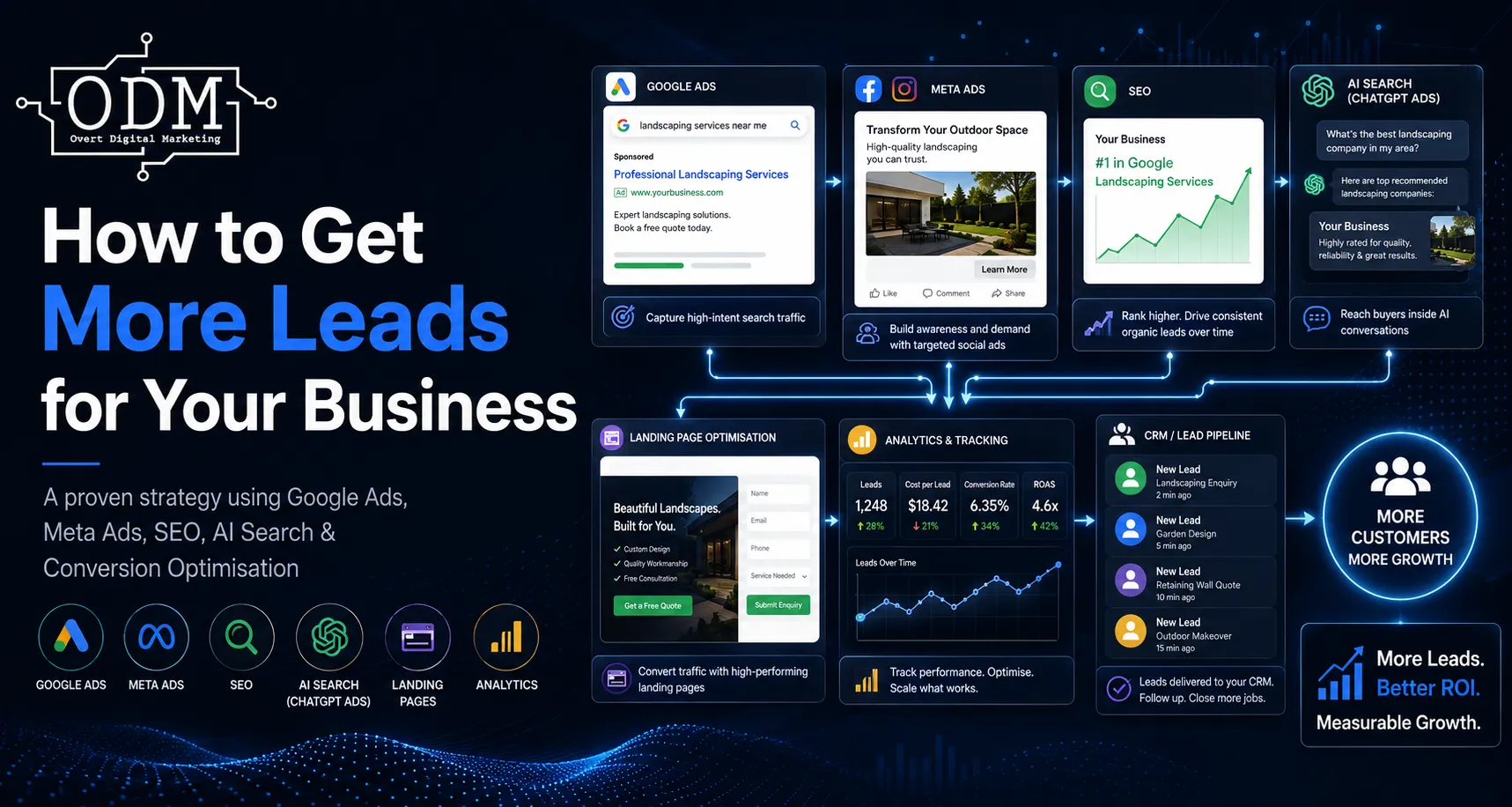
Every business owner asks this question at some point, but asking it and acting on it with the right strategy are two different things. Lead generation is not a single tactic. It is a coordinated system across paid channels, organic search, landing page performance, and tracking infrastructure. When any part of that system underperforms, the whole pipeline suffers. At Overt Digital Marketing (ODM), the team works with businesses across industries to diagnose exactly where leads are being lost and build the strategy to recover them.
Getting more leads for a business starts with understanding which channels are producing qualified enquiries and which are consuming budget without return. ODM’s process begins with a full audit of existing marketing activity before a single dollar of additional spend is recommended. That audit typically surfaces a number of fixable problems: broad keyword targeting, weak ad copy, misaligned landing pages, and broken conversion tracking. Fixing those issues first creates more return from existing spend. Then ODM scales what works.
Capturing High-Intent Traffic
Search ads are the most direct form of lead generation available in digital marketing. When someone types a query into Google, that search is a declared intent. The person is actively looking for a solution. Search ads allow a business to place an offer in front of that person at that moment.
Most businesses running Google Ads are not capturing that intent effectively. Campaigns are structured around broad match keywords that attract traffic with no commercial intent. Ad copy does not differentiate the offer. Budgets are spread thin across too many ad groups, and the landing pages receiving the traffic are not built to convert. The outcome is a high cost-per-lead that makes the channel look unviable when the actual problem is execution.
ODM manages search ads with a focus on commercial intent targeting. That means building campaign structures around queries that indicate the user is close to a decision, writing ad copy that addresses a specific problem, and connecting each ad to a dedicated landing page designed around a single conversion goal. ODM also uses ongoing conversion data to eliminate wasted spend and reallocate budget to the keywords and audiences generating actual leads.
Negative keyword lists are another area where most self-managed accounts lose significant budget. Without them, Google will match ads against irrelevant queries that look superficially similar to target keywords. ODM builds and maintains negative keyword lists as a standard part of campaign management, which directly reduces cost-per-lead by cutting traffic that was never going to convert.
For Apollo Patios, this approach delivered a 198% increase in leads without a proportional increase in budget. The gains came from restructuring the campaign architecture and tightening audience targeting, not from spending more.
Generating Demand Before the Search Happens
Not every potential customer is actively searching right now. Many of them will enter the market weeks or months from now, once a need becomes pressing. Social ads on platforms like Facebook and Instagram reach those people earlier in the decision process, building awareness and preference before a Google search is ever performed.
This is where a lot of businesses misunderstand social advertising. They run awareness campaigns without a clear conversion structure behind them, collect impressions, and conclude that social does not generate leads. The issue is not the channel. It is the absence of a funnel connecting awareness to action.
ODM builds social ads campaigns with audience construction, creative, and conversion pathways working together. The audience is built around the same customer profile being targeted through search. The creative is designed to communicate a clear value proposition, not just generate engagement. And the campaign structure moves users from initial awareness through to a lead conversion action, whether that is a form submission, a call, or a direct message.
Social advertising is particularly effective for businesses with defined customer demographics, higher-value offers that require multiple touchpoints, or services that are difficult to differentiate on price alone. When integrated with a paid search strategy, social ads extend reach across the full buying cycle rather than only capturing demand that already exists.
Advertising Inside AI-Generated Responses
ChatGPT ads are a different category of paid placement. Rather than appearing beside a search result or inside a social feed, they appear within AI-generated responses on platforms like ChatGPT. The user in that environment is actively engaged, asking specific questions, and working through a problem or decision.
This format is still emerging, but the commercial intent of AI platform users is high. People using ChatGPT to research a service, compare options, or find a provider are further along in the decision process than most social media audiences. That makes ChatGPT ads well-suited to service businesses, B2B providers, and any business where the purchase decision involves research and comparison.
Building Organic Lead Volume Over Time
Paid advertising delivers leads immediately but requires continuous spend to maintain. SEO builds a different kind of asset. A well-ranked page generates enquiries consistently without ongoing ad spend. Over time, organic search typically becomes the lowest cost-per-lead channel in a business’s marketing mix.
The team at ODM manages SEO across technical optimisation, on-page content, site architecture, and off-page authority building. For businesses serving specific geographic markets, local SEO is often where the fastest initial gains are found. Ranking for location-specific queries with strong commercial intent drives highly qualified traffic that converts at a higher rate than broad organic traffic.
Technical SEO is frequently where the most significant problems sit. Slow page load times, duplicate content, crawl errors, and poor internal linking structures all suppress rankings regardless of how strong the content is. ODM conducts a technical audit as part of every SEO engagement and addresses the structural issues before investing in content development. Building content on a technically broken site produces limited results.
Content development is the other major lever. Search engines rank pages that demonstrate topical authority and answer the specific queries users are searching. ODM develops content strategies built around the commercial keywords that drive enquiries, not just traffic. The goal is ranking for terms that convert, not terms that look impressive in a traffic report.
SEO and paid search work together. Paid ads cover the commercial intent queries immediately while organic rankings are being built. Once organic positions improve, paid budget can shift toward more competitive keywords or new markets. ODM manages both channels as an integrated strategy rather than treating them as separate programmes with separate goals.
Where Leads Are Won or Lost
Landing page performance is consistently underweighted in most businesses’ lead generation strategies. A well-structured campaign driving traffic to a weak page produces poor results regardless of how good the targeting is. The landing page is where the conversion happens or fails.
ODM handles landing page optimisation as a core part of its service, not an afterthought. The work covers page structure, copy, form design, load speed, and trust signals. Every element of the page is aligned with the specific intent of the traffic arriving on it. A page built for a paid search campaign targeting emergency plumbing queries should look and read differently to a page built for a social campaign targeting kitchen renovation leads.
For The Rogers Group, landing page optimisation alone produced a 108% improvement in conversion rate with no changes to the advertising campaign. That result reflects the leverage available when conversion rate work is done properly. More leads do not always require more budget. Sometimes the budget is already there and the page is the problem.
Understanding What Is Generating Leads
Accurate tracking is the foundation of every decision in a lead generation programme. Without it, a business cannot determine which channel is performing, where budget is being wasted, or which part of the funnel is breaking down.
ODM builds Google Analytics configurations that give businesses a clear view of lead sources, campaign performance, and conversion rates by channel and campaign. That data feeds the optimisation work directly. When a channel underperforms, the data shows where and why. When a campaign delivers a strong cost-per-lead, the data supports the case for scaling it.
For businesses running multiple paid channels, attribution is a recurring source of confusion. Google Ads, Meta, and organic search all claim credit for the same leads. ODM sets up attribution models that reflect the actual customer journey rather than defaulting to last-click attribution, which systematically undervalues upper-funnel channels like social advertising. Getting attribution right means budget decisions are based on accurate data, not misleading reports.
Monthly reporting is standard across all ODM client relationships. Reports focus on business outcomes: cost per lead, lead volume by channel, and conversion rates at each stage of the funnel. ODM does not report on impressions and clicks as primary success metrics. The reporting reflects what the business actually cares about, which is qualified enquiries and what it costs to generate them.
Managing Lead Generation Across Multiple Channels
Running a single channel in isolation limits results. Businesses that generate the most consistent lead volume typically run paid search, social advertising, and SEO simultaneously, with each channel covering a different part of the buying cycle.
Paid search captures users who are already looking. Social ads build awareness among users who will be looking soon. SEO compounds organic visibility over time and reduces dependency on paid spend. ChatGPT advertising adds presence in the AI search environment where a growing share of commercial research is happening. And landing page optimisation ensures the traffic from all of those channels actually converts.
ODM manages all of those channels as a unified strategy. Clients do not need to coordinate between multiple agencies or manage vendor relationships across different disciplines. The team at ODM handles the full scope, and the strategy is consistent across channels because the same team built it.
The Right Partner for Lead Generation
ODM works with businesses that need measurable outcomes from their marketing spend. The focus is not on activity metrics or campaign outputs. It is on leads, cost-per-lead, and revenue impact. That orientation shapes how the team plans campaigns, how it reports on performance, and how it prioritises work across the engagement.
Getting more leads for a business is a problem with a structured solution when approached with the right data and the right channel mix. ODM has delivered that for clients including Apollo Patios, The Rogers Group, Cove Training, and Clipex, across industries and budget levels.
Businesses that are ready to build a lead generation system that performs consistently across channels should contact the team at ODM for a free consultation.