
Digital advertising has always been a moving target, but every now and then an update lands that forces marketers to rethink how they measure success. The recent changes announced by Meta around click attribution are one of those moments. If you are running campaigns across Facebook or Instagram, this is not just another backend tweak. It has real implications for how performance is tracked, interpreted, and ultimately optimised.
In our view, this update is part of a much broader shift in digital marketing where platforms are tightening the way attribution works, reducing ambiguity, and pushing advertisers toward more accurate data. That sounds like a positive move, and in many ways it is, but it also introduces new challenges that businesses need to understand quickly.
This article breaks down the Meta click attribution update in detail, explains how it affects your campaigns, and outlines what you should be doing right now to stay ahead.
Understanding Meta Click Attribution
At its core, Meta click attribution determines how credit is assigned to ads when a user takes action after clicking. That action might be a purchase, a lead form submission, or even something as simple as a page view depending on how your tracking is configured.
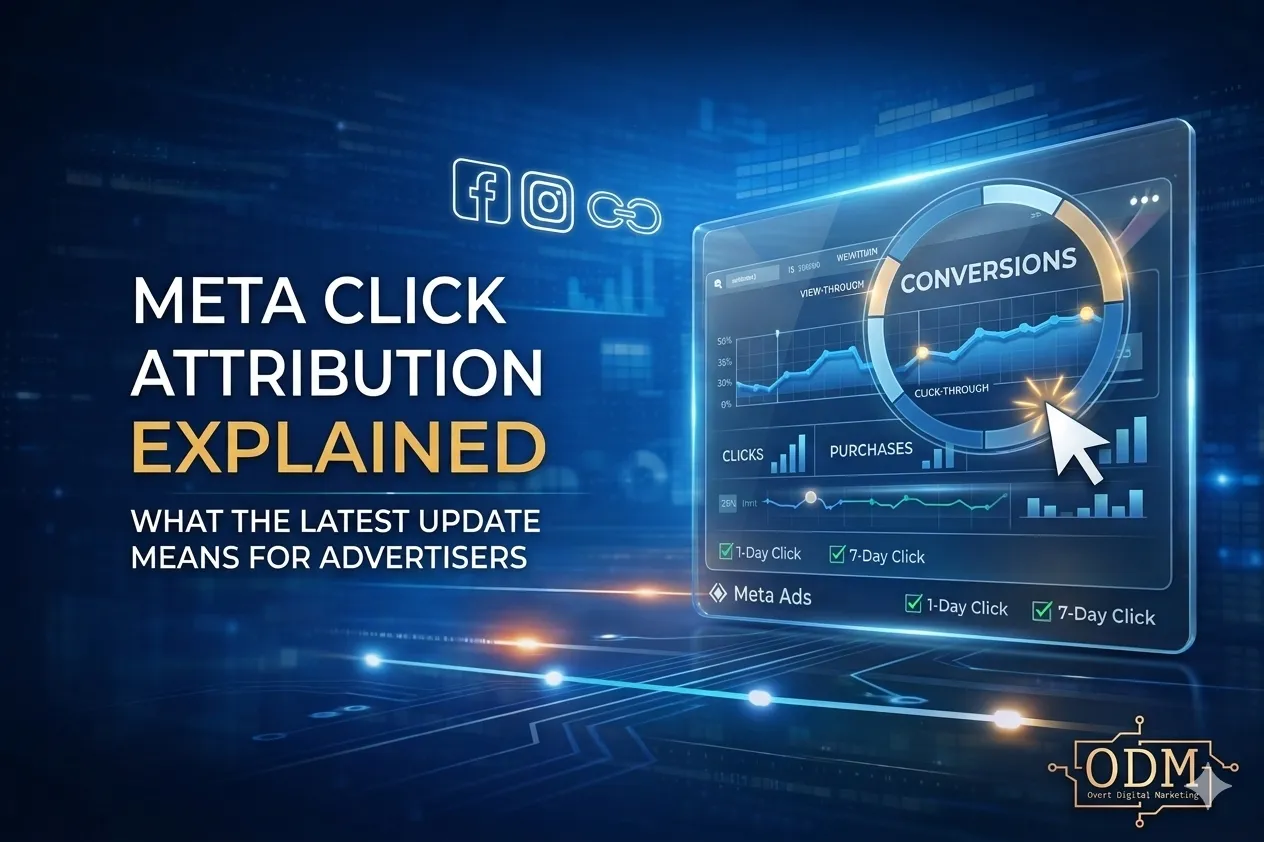
Historically, Meta has offered multiple attribution windows. These include options like seven day click, one day click, or even view through attribution where a user does not click but still converts later. The flexibility has been useful, but it has also created confusion. Different attribution windows often tell very different performance stories.
With the new Meta click attribution update, the platform is narrowing its focus. It is placing greater emphasis on click based interactions and refining how those interactions are counted. It is clear that Meta is trying to prioritise signals that show stronger intent.
We think this is a direct response to increasing privacy restrictions and reduced tracking capabilities across devices and platforms. When data becomes less reliable, platforms naturally lean toward the most deterministic signals available. A click is one of the strongest.
What Has Actually Changed
The update introduced by Meta focuses on how click attribution windows are applied and how conversions are reported back to advertisers. While the full technical breakdown is quite detailed, the key takeaway is that Meta is refining how it attributes conversions to clicks, particularly in shorter attribution windows.
In simple terms, the platform is moving toward a more conservative and arguably more realistic view of performance. Conversions are less likely to be over attributed to ads that may not have played a meaningful role in the customer journey.
It is clear that Meta is aiming to reduce inflated performance metrics that have historically come from longer attribution windows. For advertisers who have relied heavily on seven day or even longer attribution models, this shift may initially feel like performance is dropping.
In reality, the performance is not necessarily worse. It is just being measured differently.
Why This Matters More Than You Think
At first glance, it might seem like a minor reporting change. But when you dig deeper, Meta click attribution has a direct impact on decision making across your entire marketing strategy.
If your campaigns suddenly show fewer conversions, budgets may be cut prematurely. If attribution windows shrink, remarketing strategies might appear less effective. If reporting becomes stricter, stakeholders may question the value of paid media.
This is where many businesses get it wrong. They react to the numbers without understanding what has changed behind the scenes.
In our view, the smarter approach is to recalibrate expectations and align your reporting with the new attribution model. It is not about chasing the same numbers you had before. It is about understanding what the new numbers actually represent.
The Shift Toward Click Based Accuracy
There is a strong argument that Meta click attribution is becoming more aligned with real user intent. When someone clicks an ad, they are actively engaging. That is very different from simply seeing an ad and converting later through another channel.
It is clear that click attribution provides a cleaner and more defensible data point. While view through attribution has its place, it has always been more speculative.
We think Meta is making a strategic decision here. By focusing on click based attribution, they are helping advertisers build campaigns around measurable actions rather than assumptions.
This does not mean upper funnel campaigns lose value. It simply means that their impact may need to be measured differently, perhaps through brand lift studies or assisted conversions rather than direct attribution.
How This Impacts Campaign Performance
One of the immediate effects of the Meta click attribution update is a potential drop in reported conversions. This can be alarming, especially for businesses that are used to seeing strong numbers under broader attribution windows.
However, it is important to understand that this is not necessarily a negative outcome. In many cases, it is a correction rather than a decline.
Campaigns that rely heavily on retargeting or long consideration cycles may feel the impact more strongly. On the other hand, campaigns with clear and immediate calls to action may remain relatively stable.
In our experience, this type of update often separates well structured campaigns from those that rely on inflated attribution. Businesses with strong landing pages, clear messaging, and high intent targeting tend to perform better under stricter attribution models.
What Advertisers Should Be Doing Now
The first step is to review your current attribution settings within Meta Ads Manager. Understanding which attribution window you are using is critical. If you have been relying on longer windows, you may need to adjust your benchmarks.
It is also important to align your internal reporting with the new Meta click attribution model. This means updating dashboards, client reports, and performance expectations.
We think one of the most overlooked steps is communication. If you are managing campaigns for clients or stakeholders, you need to explain these changes clearly. Otherwise, a drop in reported conversions can quickly turn into a loss of confidence.
Another key action is to strengthen your tracking setup. First party data is becoming increasingly important. Tools like conversion APIs, enhanced conversions, and proper event tracking can help ensure that you are capturing as much accurate data as possible.
The Role of Landing Pages in a Post Attribution Shift
This is where things get interesting from a strategy perspective. As attribution becomes stricter, the quality of your traffic matters more than ever.
Driving clicks is no longer enough. Those clicks need to convert.
In our view, landing pages are now one of the most critical components of campaign success. If your landing page does not align with the ad message or fails to capture user intent, the impact of stricter Meta click attribution will be even more noticeable.
We have seen this firsthand across multiple campaigns. Businesses that invest in high performing landing pages tend to maintain stronger results even as attribution models tighten.
A Real World Perspective
Let us take a simple example. Imagine a user sees your ad on Instagram but does not click. A few days later, they search your brand on Google and convert. Under broader attribution models, that conversion might have been partially credited to your Meta campaign.
With the new Meta click attribution approach, that credit may no longer exist.
Does that mean the ad had no impact? Not necessarily. But it does mean that the platform is choosing not to take credit for it.
This is where marketers need to think beyond platform level reporting. Attribution is not just about what Meta says. It is about understanding the entire customer journey.
The Bigger Picture in Digital Marketing
The Meta click attribution update is not happening in isolation. It is part of a wider trend across the industry.
Privacy regulations, browser restrictions, and changes from companies like Apple have all contributed to a more limited data environment. Platforms are adapting by refining how they measure and report performance.
It is clear that the future of digital marketing will rely more heavily on first party data and less on third party tracking. Attribution models will continue to evolve, and marketers will need to adapt quickly.
We think the businesses that succeed in this environment will be the ones that focus on fundamentals. Strong offers, clear messaging, high quality traffic, and seamless user experiences will always outperform clever attribution tricks.
In conclusion, the Meta click attribution update is a reminder that digital marketing is constantly evolving. What worked yesterday may not work tomorrow, and what gets measured today may be measured differently in the future.
In our view, this update is ultimately a step in the right direction. It encourages more accurate reporting, better decision making, and a stronger focus on real user behaviour.
However, it also requires a shift in mindset. Advertisers need to move away from vanity metrics and focus on meaningful outcomes.
Meta click attribution is not just a technical setting. It is a reflection of how we understand performance in a world where data is becoming more constrained.
If you approach it with the right perspective, it can actually improve the way you run campaigns.
And in a landscape where every click matters, that is a change worth paying attention to.
By Manesh Ram, Digital Marketing Specialist. Please follow @maneshram & Meta