
Last Updated: 29 October 2026
Advertising financial services on Facebook and Instagram is possible, but financial services is one of the more tightly controlled advertising categories on Meta.
For Australian advertisers, compliance now goes well beyond writing acceptable ad copy. Meta requires qualifying financial services advertisers targeting Australian consumers to complete financial advertiser verification. Depending on the business, this can include verifying who benefits from and pays for the advertising and providing Australian Financial Services Licence (AFSL) information where applicable, or declaring an applicable exemption.
Meta also applies its wider Advertising Standards to the product being advertised, the claims being made, the creative, targeting and the destination people reach after clicking.
This means a legitimate and appropriately licensed financial business can still have an advertisement rejected.
The key is understanding that there are several different layers of compliance involved.
Quick Guide: What Should Australian Financial Advertisers Check?
Before launching financial services ads on Facebook or Instagram, check the following:
| Check | What to Review |
|---|---|
| Financial advertiser verification | Has the required Meta verification been completed? |
| Beneficiary and payer | Are the correct people or organisations verified and selected? |
| AFSL or exemption | Is the appropriate licence information or applicable exemption recorded? |
| Product eligibility | Does Meta permit advertising of this particular financial product or service? |
| Age targeting | Ads promoting credit cards, loans or insurance services must target people aged 18 or older. |
| Personal attributes | Does the copy imply knowledge of someone’s financial circumstances? |
| Financial claims | Are outcomes, savings, returns or approvals being exaggerated or guaranteed? |
| Personal and financial information | Does the ad or associated experience request information Meta does not permit advertisers to request directly? |
| Landing page | Does the destination accurately represent the offer and business? |
| Disclosures | Are required legal and regulatory disclosures present? |
| Business information | Is it clear who is providing the financial product or service? |
Passing one of these checks does not automatically mean an advertisement will pass all the others.
A business can be properly licensed and verified but still have an advertisement rejected because of its copy or offer. Likewise, perfectly written creative will not solve a verification problem or make a prohibited financial product eligible to advertise.
What Changed for Financial Services Advertising on Meta in Australia?
Meta began rolling out additional verification requirements for financial services advertisers targeting Australians in December 2024. The requirements took full effect from the end of February 2025.
The changes were introduced as part of Meta’s efforts to reduce financial scams and the impersonation of legitimate financial institutions and public figures.
Qualifying advertisers are required to verify information about the beneficiary and payer of financial services advertising.
In practical terms:
- the beneficiary is the person or organisation that benefits from the advertisement
- the payer is the person or organisation paying for the advertisement
Where applicable, advertisers must also provide their Australian Financial Services Licence information. Businesses that are legitimately exempt from holding an AFSL can declare the applicable exemption as part of the verification process.
Once the appropriate information has been verified and selected during ad creation, financial services advertisements can display verified payer information through Meta’s advertising transparency features.
For Australian financial businesses, verification should now be treated as part of campaign setup rather than something to investigate only after advertisements start being rejected.
For a step-by-step explanation of the verification process, including beneficiary and payer verification, AFSL information and exemptions, see our guide to Meta financial services ad verification.
What Changed Again in Meta’s Financial Services Policy in October 2026?
Meta continues to tighten advertiser verification as part of its wider response to financial scams.
On 26 October 2026, Meta updated the wording of its Financial and Insurance Products and Services advertising policy.
The current policy states that advertisers promoting financial products and services are required to verify their business and/or individual identity. Advertisers must also demonstrate that they are authorised by the relevant regulatory authorities where regulatory authorisation is required.
Meta may review that authorisation.
This broader identity and authorisation requirement sits alongside country-specific processes such as Australia’s financial advertiser verification requirements.
For businesses operating across multiple countries, this distinction is important. Completing the Australian requirements does not necessarily mean the advertiser has satisfied every requirement for advertising financial products in another market.
Financial advertising requirements should therefore be checked for each country being targeted.
Advertisers can review Meta’s current Financial and Insurance Products and Services advertising policy before launching campaigns.
Which Financial Services Ads Require Verification in Australia?
Meta’s Australian financial advertiser requirements extend beyond investment advertising.
Financial services advertising can include areas such as:
- insurance products
- mortgages
- loans
- investment products and opportunities
- credit cards
- credit applications
- other financial products and services
The exact requirements can depend on the product, advertiser and regulatory position.
Businesses should therefore not assume they fall outside Meta’s financial advertising requirements simply because they are not a bank, investment fund or financial planner.
Mortgage brokers, insurance businesses, lenders, fintech businesses and other organisations promoting financial products may all need to consider Meta’s financial advertising requirements.
Do You Need an AFSL to Advertise Financial Services on Meta?
Not every Australian business advertising something related to finance necessarily holds its own Australian Financial Services Licence.
Meta’s Australian verification process accommodates situations where an advertiser is legitimately exempt from holding an AFSL.
The important point is not to select an exemption simply to get through verification.
If your business does not hold an AFSL, you need to understand the regulatory basis under which your business provides or promotes the relevant service and complete Meta’s verification process accordingly.
If there is uncertainty about whether your business requires a particular licence or qualifies for an exemption, that is a regulatory question and should be confirmed with an appropriately qualified compliance or legal adviser.
A digital marketing agency should not determine a customer’s financial licensing obligations.
Are Some Financial Products Completely Prohibited From Meta Ads?
Yes.
Verification does not make every financial product eligible to advertise.
Meta prohibits advertising for a number of financial products and business models it considers particularly high risk or commonly associated with misleading or deceptive practices.
These include products and services such as:
- payday loans
- paycheck advances
- bail bonds
- short-term loans requiring repayment in full within 90 days or less
- binary options
- contracts for difference (CFDs)
- initial coin offerings (ICOs)
- penny auctions and similar bidding-fee auction models
- misleading or deceptive student loan consolidation, forgiveness or refinancing services
This is an important distinction between a restricted product and a prohibited product.
A restricted financial product may be eligible to advertise when the advertiser meets Meta’s verification, policy and applicable regulatory requirements.
A prohibited product cannot simply be made compliant by changing the headline, creative or landing page.
What About Cryptocurrency Ads?
Cryptocurrency advertising is subject to separate Meta requirements.
An initial coin offering is prohibited, but that does not mean every cryptocurrency-related product or service is automatically prohibited.
Some cryptocurrency products and services may be eligible to advertise subject to Meta’s applicable requirements and prior permission.
Businesses advertising cryptocurrency products should therefore check Meta’s current cryptocurrency advertising requirements rather than relying solely on the general financial services policy.
Are There Age Restrictions for Financial Services Ads on Meta?
Yes.
Meta requires advertisements promoting credit cards, loans or insurance services to target people aged 18 or older.
Other financial products may also be subject to additional age restrictions under applicable laws or other Meta policies.
Age settings should therefore be checked before campaign launch rather than assuming that Meta will automatically apply the appropriate restriction.
Can Financial Services Ads Request Personal or Financial Information?
Financial advertisers also need to be careful about the information they request directly through advertising experiences.
Meta restricts advertisers from requesting certain types of personally identifiable and financial information directly through ads.
This is particularly relevant when using Meta lead-generation forms or designing a financial services enquiry process.
The exact information being requested should be reviewed against Meta’s current Advertising Standards before launching the campaign.
This does not mean financial businesses cannot qualify potential customers.
It means lead qualification needs to be designed around what Meta permits advertisers to request through its advertising products, while also complying with applicable Australian privacy, financial services and consumer laws.
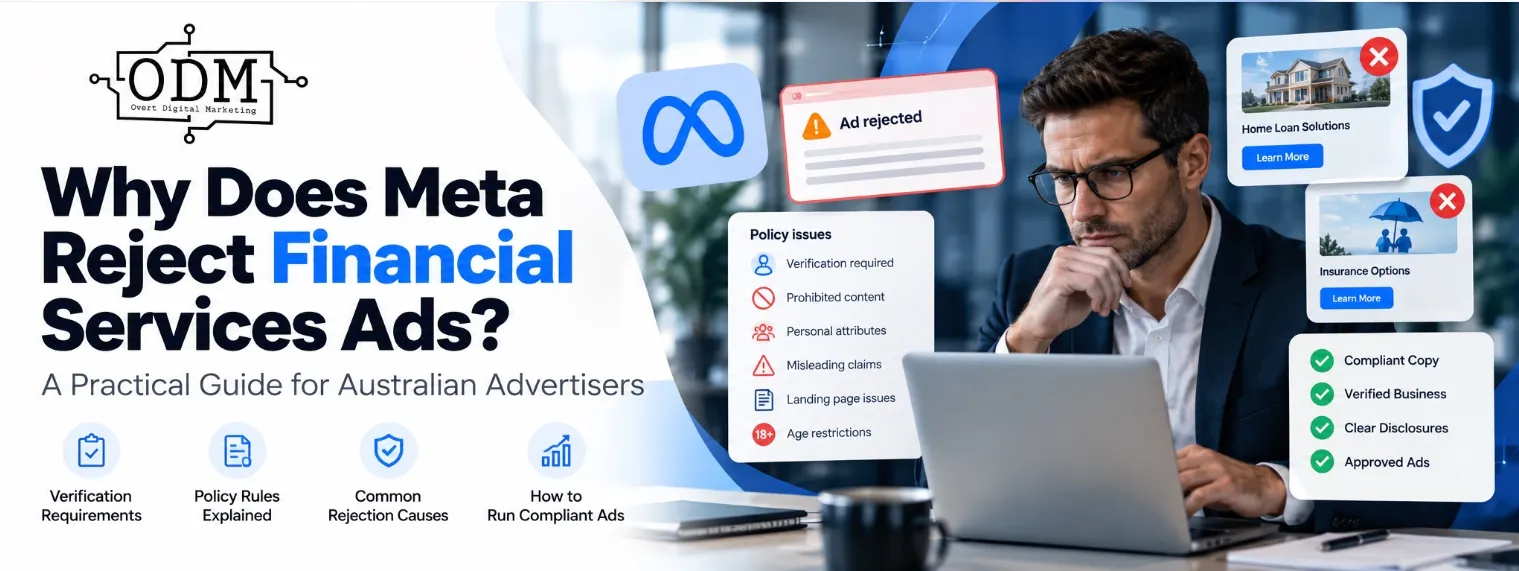
Why Does Meta Reject Legitimate Financial Services Ads?
A financial services advertisement can be rejected for several different reasons.
Common areas to investigate include:
- incomplete financial advertiser verification
- incorrect beneficiary or payer information
- licensing or authorisation issues
- a prohibited financial product
- incorrect age targeting
- personal-attribute language
- misleading or unrealistic financial claims
- prohibited requests for personal or financial information
- missing or inadequate disclosures
- problems with the destination or landing page
- a mismatch between the advertisement and the product being offered
- wider account or business-asset compliance issues
The rejection notice in Ads Manager should be the starting point, but the wording of the notice does not always make the underlying issue immediately obvious.
That is where a broader review of the campaign, account and destination may become necessary.
What Is Meta’s Personal Attributes Policy?
One of the most common areas of confusion for financial advertisers is Meta’s Personal Attributes policy.
Meta does not want advertisements asserting or implying that the advertiser knows sensitive personal information about the person seeing the ad.
This includes a person’s vulnerable financial status.
The difference can be subtle.
Consider these examples.
Higher-Risk Wording
“Struggling with debt?”
This directly suggests that the person seeing the advertisement is experiencing a particular financial problem.
Better Approach
“Explore debt consolidation options.”
This talks about the service without asserting that the person seeing the advertisement is in debt.
Another example:
Higher-Risk Wording
“Is bad credit stopping you from getting a loan?”
The advertisement makes an assumption about the viewer’s credit situation.
Better Approach
“Learn about loan options and eligibility requirements.”
The second version discusses the subject without claiming to know anything about the viewer.
The objective is not to hide what the business does.
It is to describe the product, service, problem or information without presenting sensitive personal circumstances as though they are known facts about the person viewing the advertisement.
Does Meta Have a List of Banned Financial Words?
There is no simple public list of financial words that automatically causes an advertisement to be rejected.
This is an important misconception.
Words such as debt, loan, mortgage, credit or investment are not automatically prohibited simply because they relate to finance.
The context matters.
For example, there is an important difference between:
“Learn how debt consolidation works.”
and:
“You are drowning in debt. Get out of debt immediately.”
Likewise, advertisers should be careful with language that makes unrealistic or guaranteed promises.
Examples requiring particular caution include claims around:
- guaranteed returns
- guaranteed approval
- risk-free investments
- instant financial outcomes
- unrealistic savings
- rapid debt elimination
- guaranteed improvements to financial circumstances
The objective should not be to find alternative words that somehow bypass Meta’s review system.
The better approach is to make sure the underlying claim itself is accurate, supportable and compliant.
Can Meta Reject an Ad Because of the Landing Page?
Yes.
Meta’s ad review can include the landing page or other destination associated with an advertisement, not just the ad creative itself.
This means changing the advertisement while leaving a problematic landing page unchanged may not solve the underlying issue.
For a financial services landing page, we recommend checking whether:
- the business is clearly identified
- the advertised service matches the landing page
- claims are accurate and supportable
- applicable licence information is displayed appropriately
- required disclosures are present
- fees, rates or conditions are disclosed where required
- the privacy policy is accessible
- forms work correctly
- the page does not use deceptive design or false urgency
- testimonials and reviews are genuine and appropriately presented
- contact information is clear
- the customer can understand what happens after submitting an enquiry
Not every item above is a standalone Meta requirement in every situation.
They are also good advertising, transparency and conversion practices for financial services businesses.
The important distinction is that Meta can consider the destination during ad review, so the advertisement and landing page should be treated as one customer journey.
How Does Meta Review Financial Services Ads?
Meta relies primarily on automated technology to review advertising across Facebook and Instagram.
Its systems analyse components associated with advertisements to identify potential violations of its Advertising Standards. Human reviewers are also used in some circumstances and to help improve Meta’s enforcement systems.
Automation is necessary because of the enormous number of advertisements submitted across Meta’s platforms.
It also means review systems will not always interpret context perfectly.
A legitimate financial advertisement can therefore sometimes be rejected even when the advertiser believes it complies with the rules.
Meta can also review advertisements again after they have started running.
Approval should not be treated as permanent confirmation that an advertisement will never be reviewed again.
Likewise, the fact that one version of an advertisement was approved does not guarantee that another submission of similar creative will receive exactly the same outcome.
What Should You Do If a Financial Services Ad Is Rejected?
Do not immediately start changing random words.
Instead, diagnose the likely cause systematically.
Step 1: Read the Specific Policy Reason
Start with the policy identified in Ads Manager.
Determine whether Meta is identifying:
- a financial services issue
- a verification issue
- a personal attributes issue
- a misleading claim
- a prohibited product
- an age or data-collection issue
- a destination problem
- another Advertising Standards violation
Step 2: Check Verification
If the advertisement promotes a financial product or service to Australian consumers, check that the relevant financial advertiser verification has been completed.
Confirm that the beneficiary, payer, licence or exemption details are correct.
Step 3: Check the Product
Make sure the underlying financial product itself is eligible to advertise.
There is little value rewriting the creative repeatedly if the actual product is prohibited.
Step 4: Review the Copy
Look for wording that:
- assumes the viewer has a financial problem
- refers directly to sensitive personal circumstances
- promises an outcome
- exaggerates potential results
- creates misleading urgency
- does not accurately describe the offer
Step 5: Check Age and Information Collection
If the campaign promotes credit cards, loans or insurance, confirm that it targets people aged 18 or older.
If the campaign collects information directly through Meta, review the information being requested against Meta’s current requirements.
Step 6: Review the Landing Page
Make sure the destination is consistent with the advertisement and does not introduce claims or offers that were absent from the ad.
Step 7: Check the Wider Account
If multiple advertisements are affected, determine whether the issue is limited to one creative or whether Ads Manager shows a wider account, Page or business-asset restriction.
Step 8: Request Review Where Appropriate
If you believe an advertisement has been incorrectly rejected after checking the relevant requirements, use Meta’s available review process.
Meta allows advertisers to address rejected advertisements and request another review where available.
Do not attempt to evade enforcement by repeatedly creating new ad accounts, Pages or Business Portfolios.
Trying to circumvent enforcement can create a much larger problem than the original rejected advertisement.
Can Meta Restrict Your Ad Account or Facebook Page?
Yes.
Meta can take enforcement action beyond an individual advertisement.
Depending on the issue, enforcement can affect ad accounts, Pages, Business Portfolios and other business assets.
However, it is misleading to describe every Page or account restriction as a permanent “blacklist”.
The appropriate response depends on what has actually been restricted and why.
If an account or business asset is restricted:
- identify the stated reason
- check verification and business information
- review recent rejected advertising
- resolve genuine policy problems
- use the review or support options Meta makes available
Opening new accounts or business assets to work around an existing enforcement action should not be treated as a legitimate solution.
Is Meta’s Financial Products and Services Special Ad Category the Same as Australian Verification?
No. They are separate Meta requirements.
Australia’s financial advertiser verification requires eligible financial services advertisers targeting Australian consumers to verify beneficiary and payer information and provide applicable licensing or exemption information.
Meta also operates a Financial Products and Services Special Ad Category in certain markets, which can restrict targeting options for applicable campaigns.
Australian advertisers running campaigns internationally should check whether the Special Ad Category applies in each market they target.
Do not assume that targeting restrictions documented for financial campaigns in markets such as the United States automatically apply to an Australian-only campaign.
Can Financial Services Businesses Still Generate Leads Through Meta?
Yes.
The additional rules do not mean financial services businesses should abandon Facebook and Instagram advertising.
They mean campaigns need to be built with the regulatory and platform environment in mind from the beginning.
A strong financial services campaign still needs the same fundamentals as other lead generation campaigns:
- a clear offer
- relevant creative
- accurate messaging
- appropriate audience strategy
- a strong landing page or lead form
- reliable conversion tracking
- effective lead qualification
- timely follow-up
- measurement of lead quality after the enquiry
Compliance is a prerequisite for advertising, not a guarantee of campaign performance.
A campaign can be fully compliant and still perform poorly.
Likewise, a campaign can generate a large number of leads while producing very few genuine opportunities.
The goal should not simply be to get financial services ads approved. It should be to generate relevant enquiries that have a realistic chance of becoming customers.
Should Financial Services Businesses Use Google Ads as Well as Meta?
For many businesses, yes.
Meta and Google can play different roles in the customer journey.
Meta can help businesses reach and educate potential customers who may not currently be searching for a financial provider.
Google Search can capture people actively searching for services such as mortgage brokers, financial advice, insurance or lending options.
However, Google also has strict financial services advertising requirements.
Advertisers promoting financial services in Australia may need to complete Google’s own financial services verification process. Depending on the advertiser, Google can require evidence of appropriate authorisation, approved third-party status or an applicable exemption.
Moving from Meta to Google therefore does not eliminate financial-services compliance requirements.
A better strategy is to determine which channels fit the service, audience and customer journey, then make sure the business meets the requirements of each platform.
Google’s current Australian requirements are available in its Financial Services Verification policy for Australia.
How Can Financial Services Advertisers Reduce Meta Ad Rejections?
There is no way to guarantee that an advertisement will never be rejected, particularly when automated review is involved.
However, businesses can reduce avoidable problems by building compliance into the campaign process.
1. Complete Verification Early
Do not wait until the campaign is ready to launch before investigating financial advertiser verification.
2. Confirm the Correct Business Details
Make sure beneficiary, payer, business and licence information is accurate and consistent.
3. Understand the Product Being Advertised
Determine whether the product is permitted, prohibited or subject to additional requirements.
4. Check Age Requirements
Make sure credit card, loan and insurance campaigns target people aged 18 or older.
5. Write About the Service, Not the Viewer’s Personal Situation
Avoid copy that assumes the person seeing the advertisement has debt, bad credit, financial hardship or another sensitive financial circumstance.
6. Avoid Unsupported Outcomes
Do not promise approvals, returns, savings or financial improvements that cannot be substantiated.
7. Review Lead-Form Questions
Make sure information collected directly through Meta complies with its current advertising requirements.
8. Review the Landing Page With the Ad
Treat the advertisement and destination as one customer journey.
9. Make Compliance Information Easy to Find
Where licences, disclosures or other information are required, do not make customers search for them.
10. Keep Records
Maintain copies of verification information, licences, exemptions, approved advertising and relevant compliance documentation.
11. Check Requirements When Entering New Markets
Do not assume Australian verification automatically covers campaigns targeting other countries.
12. Monitor More Than Ad Approval
Once campaigns are running, measure lead quality, qualified opportunities and actual customer outcomes rather than judging performance solely by Meta’s reported lead count.
How Does ODM Approach Financial Services Advertising?
Financial services advertising requires more than getting an advertisement approved.
At Overt Digital Marketing (ODM), we look at the wider campaign system, including campaign structure, advertising creative, conversion tracking, landing pages and the quality of the enquiries being generated.
Where Meta’s advertising policies apply, our role is to help structure and manage advertising within the platform requirements.
Where financial licensing, regulatory interpretation or legal approval is required, that remains a matter for the business and its appropriately qualified compliance or legal advisers.
This distinction is important.
A digital marketing agency can help identify advertising-policy risks and build campaigns around platform requirements. It should not replace the regulatory advice a financial services business may need.
For financial advertisers, we are particularly interested in what happens after Meta records a lead.
Are the enquiries relevant?
Can the sales team contact them?
Do they meet the basic qualification criteria?
Are they becoming genuine opportunities?
Are particular campaigns or creative variations producing better customers?
That information provides a much stronger basis for optimisation than simply trying to generate the largest possible number of form submissions.
Frequently Asked Questions About Meta Financial Services Ads
Can financial services advertise on Facebook and Instagram?
Yes. Many financial products and services can be advertised on Facebook and Instagram, provided the product is permitted and the advertiser meets Meta’s applicable verification, authorisation, advertising and disclosure requirements.
Some financial products are prohibited completely.
Do Australian financial services advertisers need Meta verification?
Qualifying advertisers promoting financial products and services to Australian audiences are required to complete Meta’s applicable financial advertiser verification requirements.
This can include verification of beneficiary and payer information and AFSL information where applicable, or an appropriate exemption.
Do I need an AFSL to run Facebook ads?
Not every advertiser is necessarily required to hold its own AFSL. Meta’s Australian verification process accommodates applicable exemptions.
Whether your business legally requires an AFSL is a regulatory matter and should be confirmed with an appropriately qualified adviser where there is uncertainty.
Why does Meta keep rejecting my financial ads?
Possible causes include incomplete verification, an ineligible financial product, incorrect age targeting, personal-attribute wording, misleading claims, inappropriate information requests, disclosure issues, landing-page problems or a wider account restriction.
Check the policy reason shown in Ads Manager before making changes.
Can I say “struggling with debt” in a Facebook ad?
That wording is risky because it directly implies that the person seeing the advertisement has a particular financial problem.
It is generally better to discuss the service or subject itself, such as “Explore debt consolidation options”, without asserting the viewer’s personal financial circumstances.
Does Meta ban words such as debt, loan or mortgage?
Meta does not publish a simple list where ordinary financial words such as debt, loan or mortgage are automatically banned.
The meaning, context, claim and overall advertisement matter.
Can cryptocurrency businesses advertise on Meta?
Some cryptocurrency products and services may be eligible to advertise subject to Meta’s separate cryptocurrency advertising requirements and prior permission.
However, certain products, including initial coin offerings, are prohibited.
What age can financial services ads target on Meta?
Meta requires advertisements promoting credit cards, loans or insurance services to target people aged 18 or older.
Other financial products may be subject to additional requirements.
Does Meta review the landing page?
Yes. Meta’s ad review can include the landing page or other destination associated with the advertisement.
Financial advertisers should therefore review the advertisement and landing page together rather than assuming approval depends only on the text and image inside the ad.
Can Meta restrict an entire ad account?
Yes. Meta can take enforcement action against advertising accounts and other business assets, not just individual ads.
The appropriate response is to identify and resolve the underlying issue and use Meta’s available review process rather than attempting to circumvent the restriction.
Can I create another ad account if my financial ads are restricted?
Creating new accounts or business assets to evade an existing enforcement action is not an appropriate solution and can create additional problems.
Investigate the reason for the restriction first.
Is Meta financial advertiser verification the same as the Financial Products and Services Special Ad Category?
No.
Australian financial advertiser verification and Meta’s Financial Products and Services Special Ad Category are separate requirements.
The Special Ad Category applies in certain markets and can restrict targeting options. Australian businesses advertising internationally should check the requirements for each country they target.
Is Google Ads easier for financial services than Meta?
Not necessarily.
Google can be particularly valuable for capturing high-intent financial searches, but it has its own Australian financial services verification and advertising requirements.
The better platform depends on the service, target audience, customer journey and campaign objective.
Can an agency complete Meta financial services verification for me?
An agency can assist with the advertising setup and help identify what Meta is requesting, but licence, exemption and regulatory information must accurately reflect the financial services business and its legal position.
The business should provide or confirm the appropriate regulatory information.
Final Thoughts
Financial services is one of the more tightly controlled areas of digital advertising, and the requirements continue to evolve.
For Australian advertisers, successful Meta advertising now starts before the first ad is written.
The business needs to understand whether verification applies, ensure the correct beneficiary and payer information is in place, provide the appropriate licensing or exemption information, confirm that the product can be advertised and then build creative and landing pages that comply with Meta’s wider Advertising Standards.
Even then, approval is only the first step.
The real objective is to turn advertising spend into relevant enquiries, qualified opportunities and customers.
If your financial services campaigns are experiencing repeated ad rejections, verification problems or poor-quality enquiries, Overt Digital Marketing can review the advertising setup, campaign structure, creative, landing pages and conversion tracking to identify where the problem may be occurring.
Policy information reviewed: 29 October 2026.
Meta regularly changes its advertising policies and verification processes. Businesses should check Meta’s current requirements and obtain appropriate regulatory or legal advice where necessary before advertising regulated financial products or services.