
If you have been running campaigns through Meta Platforms for any length of time, you will know that performance often comes down to one thing: data quality. The better the data feeding your pixel, the better Meta can interpret user behaviour, match intent, and ultimately deliver results that translate into leads or revenue.
Meta has now taken a significant step in that direction with its latest rollout of automatic event enrichment. While on the surface this might look like a simple backend update, in our view it represents a meaningful shift in how advertisers can leverage AI to improve campaign performance without increasing operational complexity.
Let’s break down what this update actually does, how it impacts your campaigns, and what you should be thinking about from a strategic perspective.
A Shift Towards Smarter, Automated Data Collection
Traditionally, setting up a Meta Pixel properly has required a mix of developer input, event configuration, and ongoing validation. Advertisers often had to manually define parameters such as product IDs, page types, or content categories to ensure campaigns had enough context to optimise effectively.
With automatic event enrichment, Meta is removing much of that manual effort.
This feature uses AI to automatically identify and send additional information from your website through the pixel. That includes:
- Page-level details such as content type and structure
- Media-related context
- Business location signals
- Product-specific information for catalogue-based campaigns
The key point here is that none of this requires manual implementation. There is no need to adjust your existing setup, rewrite code, or rebuild campaigns. The feature simply enhances what is already being captured.
What Actually Changes When This Is Enabled
Once active, your pixel begins sending richer, more detailed event data back to Meta. This has a compounding effect across multiple areas of your account.
- Automatic Event Enrichment
Your existing events are no longer just basic signals like page views or purchases. They become layered with contextual data that helps Meta better understand what each interaction represents.
In practical terms, this means your campaigns are no longer optimising on shallow signals. They are optimising on intent.
- Improved Ad Delivery and Performance
Meta’s algorithm relies heavily on pattern recognition. The more context it has, the better it can match ads to users who are likely to convert.
With richer data inputs, Meta can:
- Identify higher-quality audiences
- Refine targeting beyond surface-level behaviours
- Improve conversion prediction accuracy
From our perspective, this is where the real value sits. It is not just about more data. It is about better decision making at the algorithm level.
- Stronger Product Catalogue Accuracy
For eCommerce and catalogue-based advertisers, this update carries additional weight. Meta can now automatically sync and enrich product-level data, helping ensure:
- Product information remains accurate
- Catalogue feeds stay fresh
- Missing attributes are reduced
This is particularly important for dynamic ads, where outdated or incomplete product data can quietly erode performance.
- Pixel-Based Catalogue Creation
One of the more overlooked benefits is the automatic addition of required product tags on product pages. In many accounts, catalogue setup becomes a bottleneck due to incomplete tagging or inconsistent implementation. This feature helps bridge that gap by ensuring product pages contain the necessary signals for optimal catalogue performance.
Timeline and Rollout
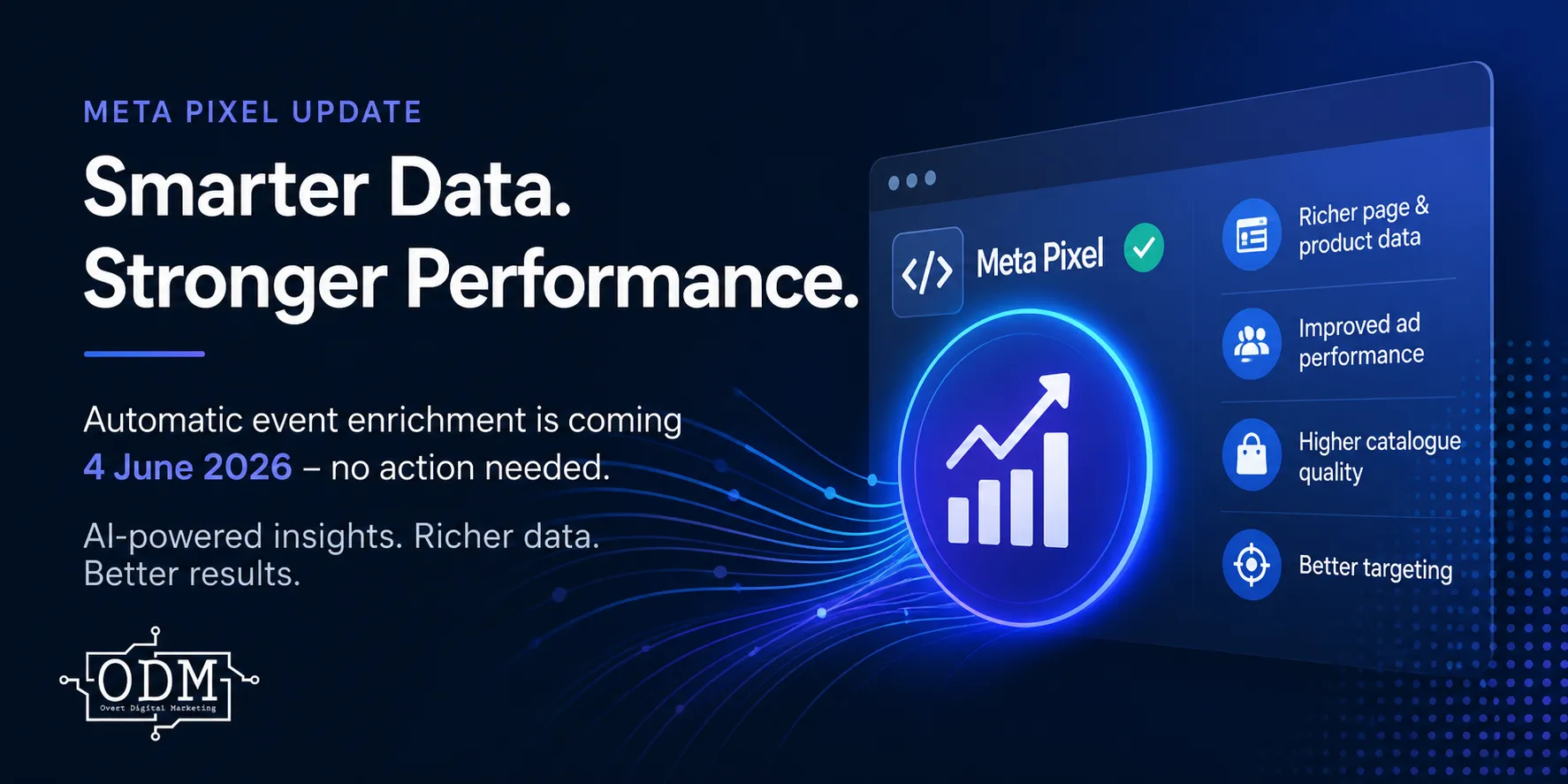
Meta has confirmed that from 4 June 2026, all eligible pixels will begin automatically including this enriched data.
For advertisers, this means:
- The feature will activate automatically
- There will be no disruption to existing campaigns
- No manual setup is required
If you prefer to move faster, the feature can be enabled immediately via Events Manager.
No Action Required… But That Does Not Mean No Strategy Required
Meta is positioning this as a “no action needed” update, and technically that is correct. However, from a performance standpoint, ignoring it would be a mistake.
Any time a platform improves the quality of signals feeding its algorithm, the advertisers who benefit most are the ones who align their strategy accordingly.
Data Control and Privacy Still Sit With You
One concern that often comes up with automation is loss of control. Meta has addressed this directly. You still retain full control over the data being shared. You can:
- Manage which data types are included
- Adjust settings within Events Manager
- Turn the feature off entirely if needed
This is important because it allows advertisers to balance performance gains with compliance requirements, especially in regions with stricter data privacy expectations.
What This Means in Practice for Advertisers
From our experience managing performance campaigns across industries, updates like this tend to create a widening gap between accounts that are structured well and those that are not.
Here is how we see this playing out.
Accounts with clean tracking, strong campaign structure, and clear conversion signals will likely see incremental gains relatively quickly. The enriched data simply enhances what is already working.
On the other hand, accounts with poor tracking foundations may not see the same level of benefit. In some cases, the additional data could even introduce noise if the underlying setup is not aligned with business goals.
Our View: This Is About Signal Quality, Not Just Automation
It is easy to look at this update and think of it as another layer of automation. In our view, it is more than that. This is about improving signal quality at scale.
Meta is effectively saying that instead of relying on advertisers to manually define every parameter, it will use AI to interpret and structure that data automatically. That reduces friction, speeds up optimisation, and allows campaigns to operate with a deeper understanding of user behaviour.
For advertisers, the opportunity lies in making sure the inputs going into that system are as clean and intentional as possible.
How to Approach This Strategically
While you do not need to take action to enable the feature, there are a few strategic considerations worth reviewing:
First, ensure your conversion events are aligned with actual business outcomes. If your primary event is not meaningful, enriching it will not suddenly make it valuable.
Second, review your website structure and content. Since Meta is now interpreting page-level data, clarity in your page hierarchy and messaging becomes more important.
Third, check your catalogue setup if you are running eCommerce campaigns. This update can enhance catalogue performance, but only if the foundation is sound.
Finally, monitor performance closely after rollout. Look for shifts in conversion rates, cost per acquisition, and audience behaviour.
In conclusion, Meta’s automatic event enrichment is one of those updates that quietly improves performance behind the scenes. There is no dramatic interface change. No complex setup. No immediate disruption. But under the hood, it strengthens the data engine that powers your campaigns.
In a landscape where platforms are increasingly driven by AI, the advertisers who win will not necessarily be the ones doing more manual work. They will be the ones who understand how to feed these systems the right signals and let the algorithms do what they are designed to do.
If you are unsure how this update fits into your broader strategy, or whether your current setup is positioned to take advantage of it, this is exactly where a performance-focused agency can make a difference.
At Overt Digital Marketing (ODM), we focus on aligning tracking, data, and campaign strategy to drive measurable growth. Updates like this are not just technical changes to us. They are opportunities to unlock better results for our clients.
If you want to make sure your campaigns are set up to benefit from Meta’s latest advancements, now is the right time to review your approach. Contact us today.
By Manesh Ram, Digital Marketing Specialist. Please follow @maneshram & Meta