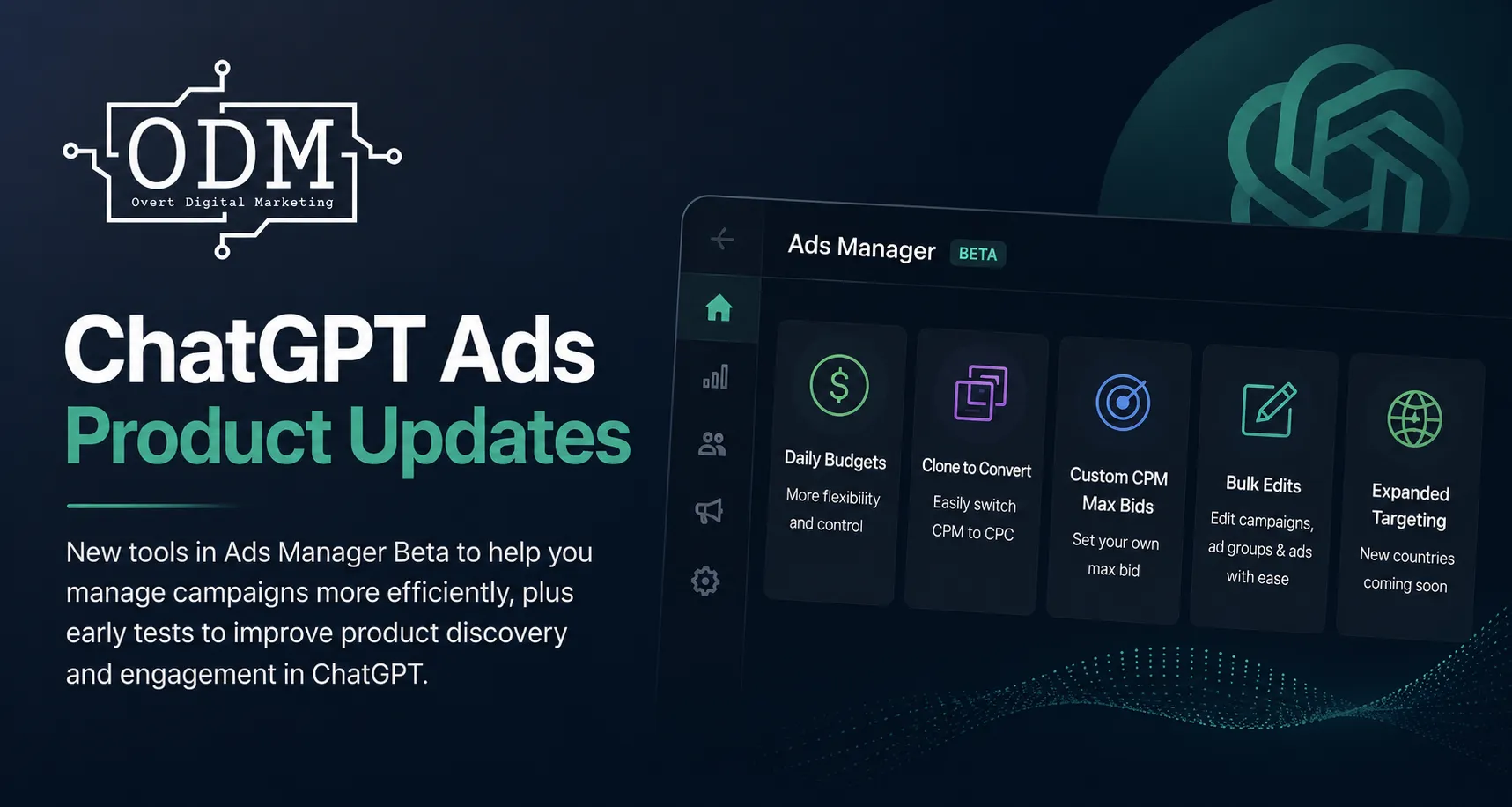

OpenAI has just released one of the most significant ecommerce advertising updates since launching ChatGPT Ads.
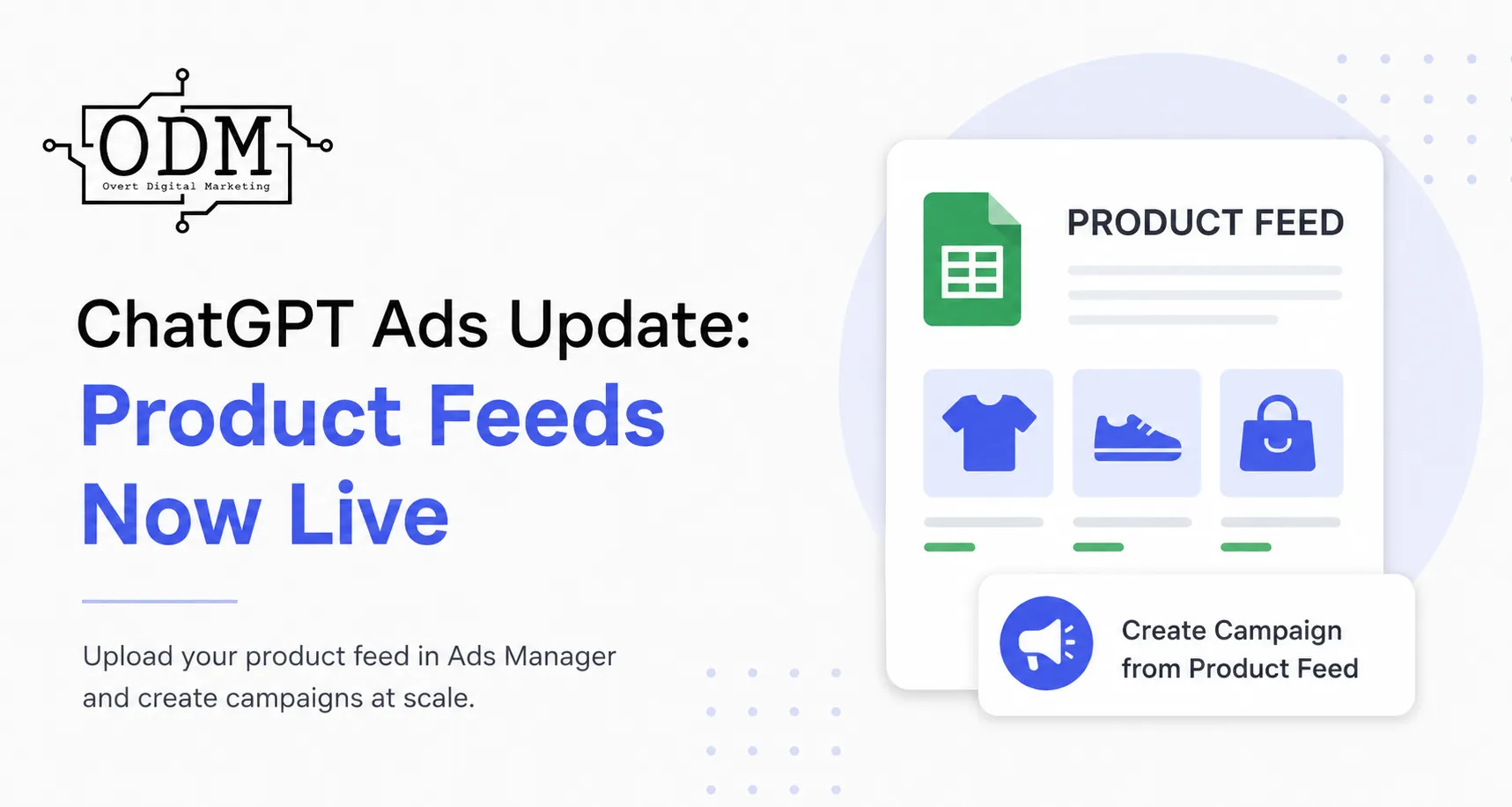
Retailers can now upload their product feeds directly into Ads Manager and create advertising campaigns from those feeds automatically. Instead of manually building ads for every product, advertisers can connect their catalogue and allow ChatGPT to create and serve ads using structured product data.
For ecommerce businesses with hundreds or even thousands of products, this is a major development. It brings ChatGPT Ads closer to established shopping platforms such as Google Shopping and Meta Advantage+ Catalog Ads, while introducing a completely new environment where products can be discovered during natural conversations.
In our view, this is one of the clearest signs yet that ChatGPT is becoming a serious advertising platform for retailers and ecommerce brands.
What Is Changing in ChatGPT Ads?
OpenAI has introduced two new capabilities inside Ads Manager.
The first is the ability to upload product feeds directly within Ads Manager. Advertisers can now navigate to the Tools section, select Feeds and upload their product catalogue to the platform. This makes it easier to bring large product ranges into ChatGPT without creating individual ads manually.
The second capability is the ability to create campaigns directly from those feeds. When creating a campaign, advertisers can now select Product Feed as the campaign type and choose which products should be included in each ad group.
This means a retailer with thousands of products can potentially create and manage campaigns at scale using a single product catalogue.
For businesses already using Google Shopping feeds or other catalogue systems, this should feel familiar. The difference is where the products are being shown.
Instead of appearing after a keyword search, ChatGPT products can appear during a conversation where users are actively exploring options, comparing products or asking for recommendations.
That is a very different customer journey.
Why Product Feeds Matter
Traditional ecommerce advertising relies heavily on keywords.
Someone searches for “running shoes”, “best office chair” or “buy coffee machine” and advertisers compete for those searches.
ChatGPT changes that behaviour.
Users often start with broader questions such as:
What is the best coffee machine for a small apartment?
Which office chair is best if I work from home all day?
What running shoes are good for beginners?
The conversation then develops naturally. Users compare products, ask follow up questions and refine their preferences before making a decision.
OpenAI describes product feed campaigns as a way to match relevant products with high intent user conversations while keeping product information and availability updated automatically.
This is important because intent in ChatGPT evolves throughout the conversation.
Research into the emerging ChatGPT advertising ecosystem suggests advertisers are beginning to target what analysts call conversational intent rather than relying solely on keywords. In other words, the user’s buying intent develops during the conversation itself.
For ecommerce businesses, this could represent a significant shift in how customers discover products online.
How Product Feed Campaigns Work
The process is currently relatively straightforward.
Advertisers create a feed inside Ads Manager and receive SFTP credentials to upload their catalogue. The product feed is then processed by OpenAI and validated before becoming available for campaigns.
Once the products have been processed, advertisers can create a new campaign and choose Product Feed from the campaign type menu.
The system then uses information from the feed, including product names, descriptions and metadata, to generate ads. OpenAI states that ad titles and descriptions are pulled directly from the product feed itself.
This places more importance on feed quality than ever before.
Businesses with poorly written product titles or incomplete descriptions may struggle to achieve strong results.
Conversely, retailers with well structured product information could gain an advantage as ChatGPT uses that information to determine relevance and generate ads.
There Are Important Requirements to Know
The feature is still in beta and there are some restrictions.
According to OpenAI, product feeds must currently be uploaded through SFTP rather than a direct integration or spreadsheet upload. Feeds must contain a minimum of 1,000 products and can contain up to 2 million products.
This minimum requirement means the feature is currently aimed more at medium to large retailers rather than small ecommerce businesses with a limited catalogue.
OpenAI also notes that products uploaded through feeds are currently only used for advertising purposes. They do not appear organically inside ChatGPT conversations, although OpenAI has suggested this capability may become available in the future.
That last point is particularly interesting.
If product feeds eventually influence both paid and organic product discovery within ChatGPT, retailers may need to start thinking about feed optimisation in much the same way they currently think about SEO.
Why This Update Is Bigger Than It Looks
At first glance, product feeds may appear to be just another ecommerce feature.
We think it is much more than that.
This update signals that OpenAI is building the infrastructure required to compete seriously in ecommerce advertising.
Until recently, ChatGPT Ads focused on campaign setup, CPC bidding, measurement and conversion tracking. Product feeds move the platform much closer to shopping and product discovery at scale.
For retailers, this could open entirely new opportunities.
Instead of waiting for someone to type a high intent keyword into Google, brands can appear while shoppers are actively researching, comparing products and seeking advice.
This resembles the way consumers naturally make purchasing decisions.
And because the interaction happens within a conversation, ChatGPT can understand context in a way that traditional search engines often cannot.
That context could become one of the most valuable assets in digital advertising over the coming years.
What Ecommerce Businesses Should Do Now
If you operate an ecommerce store, now is the time to start preparing.
The quality of your product feed will likely become increasingly important as ChatGPT advertising expands.
Product titles should be descriptive and natural.
Descriptions should explain not only what the product is, but who it is for and the problems it solves.
Images should be high quality and accurately represent the product.
Structured attributes such as colour, size, category and specifications should be complete and consistent.
Businesses that already invest in Google Shopping optimisation may have a head start. However, conversational AI introduces new challenges because products are being matched to intent expressed through natural language rather than exact keywords.
That means understanding how customers ask questions may become just as important as understanding what they search for.
The Future of ChatGPT Product Ads
OpenAI has made it clear that Ads Manager Beta is continuing to evolve and expand. Australia is among the countries currently supported for advertisers, alongside the United States, Canada and New Zealand.
Product feed campaigns are still early, but the direction is becoming increasingly obvious.
ChatGPT is evolving from an AI assistant into a product discovery engine.
For ecommerce brands, this creates a new advertising channel where customers are not simply searching for products. They are asking questions, comparing options and making purchasing decisions in real time.
In our view, product feed campaigns are one of the most important ChatGPT Ads updates released so far.
The retailers that begin preparing now will likely be in a much stronger position as conversational commerce continues to grow.
At Overt Digital Marketing, we are closely monitoring ChatGPT Ads developments and helping businesses understand how AI driven advertising is changing the customer journey. As the platform expands, we expect product feed campaigns to become an increasingly important part of the ecommerce advertising landscape.
By Manesh Ram, Digital Marketing Specialist. Please follow @maneshram & Meta