
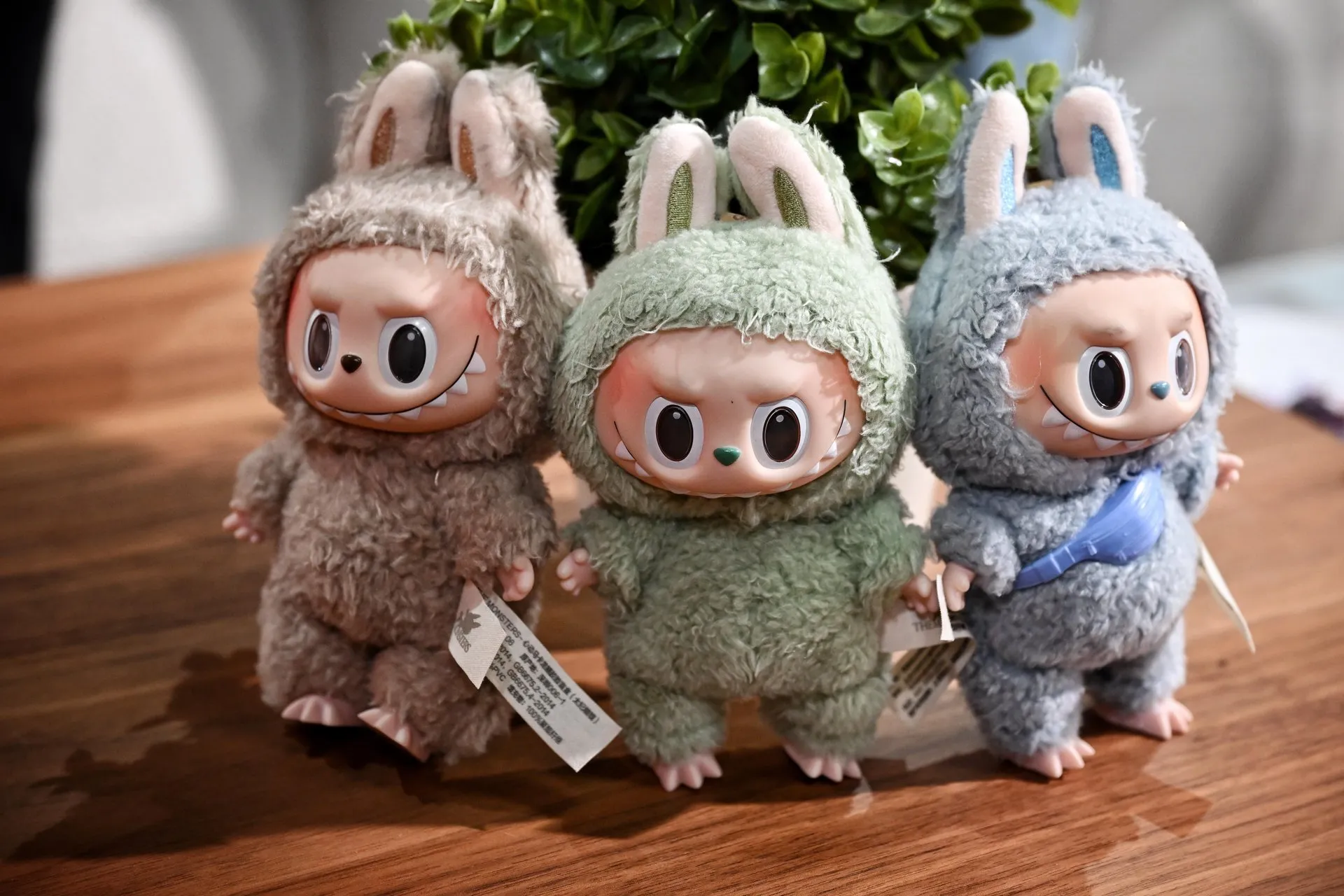
When you look at Labubu, you might be tempted to dismiss it as a quirky, oddball toy. It’s hardly “cute” in the conventional sense. But today, it sits at the staggering intersection of hype, psychology and clever brand engineering. In fact, the company behind Labubu, Pop Mart / Hotmart, has built what some call a $1.6 billion empire off this odd little figure. If there’s one thing clear, it’s not the product that carried Labubu to superstardom, it’s the marketing.
In this article, we will break down Labubu marketing strategy step by step, exploring how the brand engineered each phase of its rise and why that same system might contain the seed of its own collapse.
Why Ugly Wins
Before we dive into the five-step “hype flywheel,” it’s worth pausing on something counterintuitive: why did an “ugly” toy succeed? We think there are a few psychological levers at play.
First, the unconventional appearance gives Labubu a curious visual edge. In a saturated world of plush bunnies, cute bears and pastel figurines, Labubu stands out by being strange, uncanny and slightly unsettling. That difference invites commentary, intrigue and shareability. Second, “ugly” in this context becomes a badge of inside knowledge, if you love it, you’re in the club. That tension between outsider reaction and insider fandom helps fuel conversations.
In our view, Labubu’s looks were never a liability, they were a deliberate part of its positioning. The visual mismatch makes people ask: “What is this thing and why is it in my feed?” And once people ask, they click, share and research. That kind of organic curiosity is far harder to generate with a “safe” design.
Let’s walk through the actual marketing architecture that turned that curiosity into mass mania.
Step 1: The Spark: When Lightning Strikes
Every great trend begins with a moment that feels spontaneous. In Labubu’s case, the spark came in April 2024, when K-pop superstar Lisa posted a photo of her Labubu collection. Overnight, the internet went wild. Google Trends soared. Fans scanned marketplaces. The frenzy began, with virtually no overt paid campaign behind that post.
This was not luck alone. That post succeeded because Labubu had already placed itself in the line of sight of tastemakers. They had seeded product into influencer circles, prepared for sampling and primed micro-communities to notice. Then, in the right moment, lightning struck.
The lesson for the Labubu marketing strategy is this: you can’t guarantee the spark, but you can position yourself to catch it. The goal is to be in the right hands at the right time. Influencers, cultural icons, niche subcultures, all these people are conduits. If one of them whispers your name at the right moment, your spark is born.
Step 2: Social Amplification: Turning Every Customer into a Marketer
A single spark can get attention, but to sustain it you need fire. Labubu’s second phase was amplification and they engineered it brilliantly.
They didn’t just sell a toy; they sold shareable moments. Each Labubu release was a content opportunity: unboxing videos, surprise reveals, “which one did you get?” comparisons. Blind boxes (where the specific figure inside is unknown until you open it) turned every purchase into a mini suspense story waiting to be filmed.
As a result, customers became brand ambassadors. Every unboxing was de facto marketing content. Every new figure went on social media as a flex, or a conversation starter. The viral loop reinforced itself: people saw others opening Labubu, they wanted to open it too.
In the context of Labubu marketing strategy, amplification is not an afterthought, it is baked into the product. The packaging, the randomness, the reveal sequence are all optimized for shareability. In our view, if Labubu had simply shipped a static figure without drama, it would never have gained traction on the same scale.
Step 3: Scarcity and FOMO: Wanting What You Can’t Have
Once attention is rising, you need to throttle supply. This is where psychology enters full force.
Labubu drops are strictly limited. They never overproduce. Because the supply is constrained, scarcity becomes a selling point rather than a drawback. Additionally, the blind-box model ensures that fans must buy multiple boxes to complete sets, so they keep coming back.
The scarcity creates urgency, fuelled by social awareness: when people see others complaining “I can’t get it,” or news that “it’s sold out,” that amplifies desire. We tend to value what is rare.
This is a central pillar of the Labubu marketing strategy. Without scarcity, hype becomes noise. But when you sprinkle just enough limitation into the mix, you force tension, urgency and repeated buying behaviour.
Step 4: Resale Mania: When Scarcity Becomes News
This step moves beyond scarcity into cultural proof. Because labubu units are so limited and so sought after, a secondary market quickly emerged. That $30 toy began reselling for $200, $500, even (in one extreme case) $150,000.
Many would see that as a problem, the brand is not capturing that extra margin. But in this case, it becomes free advertising. Headlines proclaim “ugly doll sells for six figures,” and media outlets jump. The mania validates the hype. It’s proof that people take it seriously.
Every resale story becomes content: “They paid $10k for a Labubu? This is insane.” The buzz draws in casual observers, who then jump in to chase the trend.
The resale market becomes a feedback loop in the Labubu marketing strategy. The higher the resale prices, the more headlines, the more demand, the more scarcity and so on. Some consumers buy just to flip, others buy to join the tribe. Either way, the brand exposure escalates.
Step 5: Cultural Lock-In: From Toy to Identity
Up to this point, Labubu may look like a fad, a clever viral product. That’s where step five comes in: cultural lock-in.
Pop Mart expanded Labubu beyond figurines. Collaborations with big franchises (Harry Potter, Minions, DC Comics, etc.) tethered Labubu to existing fandoms. Accessories, clothing, key chains, pop-up experiential stores, everything became part of a broader lifestyle ecosystem.
Suddenly Labubu isn’t just something you buy. It becomes something you are. It signals your identity, your aesthetic, your tribe. It’s no longer a toy but a cultural icon. The deeper your identity with Labubu, the less likely you are to abandon it when trends shift.
This step is central to the Labubu marketing strategy because it builds barriers to churn. You don’t just buy a figure, you immerse in a brand world.
Step 6: The Dark Side of Hype: When Momentum Isn’t Enough
If hype is your rocket fuel, you better have a landing gear. The danger is that hype-driven brands often collapse once attention shifts. We’ve seen it with Prime Drinks post-peak. Fidget spinners in 2017. Viral products that skyrocket and then vanish.
With Labubu, the risk is dependence on viral momentum. If customers are buying because it’s the “hype toy,” what happens when the next shiny thing arrives? Without real loyalty or intrinsic value, the brand may fade as quickly as it rose.
Hype draws eyes. But loyalty keeps wallets open over time. If Labubu can’t convert speculative buyers into devoted fans, it might be the next big fad to fizzle.
Step 7: The Takeaway: Turning Hype into Longevity
From all of these steps, a few lessons emerge for anyone trying to emulate the Labubu marketing strategy:
- Spark matters, but you prepare for it in advance.
- Amplification needs to be product-enabled, not afterthought.
- Scarcity must be real and controlled.
- Resale (or any peer validation) is powerful marketing currency.
- Cultural lock-in makes your brand sticky beyond trend cycles.
- But hype alone never sustains. You must layer substance under the spectacle.
You can use components of Labubu’s approach in your own brand, but always ask: how do we outlast the hype?
Overt Digital Marketing and a retail proof point: Our Cow
If there is a practical lesson for brands chasing a Labubu marketing strategy, it is that hype only becomes growth when an operator can convert attention into clean journeys, efficient media and repeatable revenue. That is the remit of Overt Digital Marketing. ODM is a performance-focused agency that builds the connective tissue between demand and delivery. The team’s retail work with Our Cow shows how sound execution turns curiosity into customers without leaning on theatrics.
Our Cow sells premium Australian meat online. When ODM stepped in, the brief was simple in spirit but complex in practice. Fix the paths to purchase, concentrate paid spend where intent lives and let story and creative do their work inside a tighter, more measurable framework. The result is a clear proof point. The case study shows year over year, revenue lifted by 213.88 percent, transactions climbed by 216.04 percent and conversion rate improved by 103.46 percent. Those are not soft metrics. They are the compound effect of website refinement, disciplined Google and Meta campaign structures and ongoing optimisation that keeps waste low and momentum high.
What we like about this example is how neatly it maps to the lessons from Labubu. The spark can be a creator post or a timely collaboration. Amplification can come from content that people want to share. Scarcity can heighten desire. But the difference between a spike and a slope is the operating system underneath. ODM’s Our Cow work shows how a brand can welcome surges of attention and still protect the fundamentals that matter to profit. In our view, that is how you future-proof any hype cycle. You build the identity and the tribe, then you back it with infrastructure that does not break when interest surges.
If you are looking to translate a Labubu-style playbook into your own category, ODM’s approach is a useful template. Anchor the story in something people care about, make the buying experience fast and obvious, instrument every step so you can see where money is made or lost and keep iterating until the numbers tell you the machine is humming. That mix of creative spark and operational steadiness is what sustains growth once the headlines move on.
Contact us today to learn more about your Digital Marketing Strategies.
By Manesh Ram, Digital Marketing Specialist. Please follow @maneshram & Meta