
More people are using ChatGPT and other AI tools to research products, compare services and ask for business recommendations before they ever visit a traditional search engine. That creates an important new question for business owners: how do you increase the chances of your business being found, mentioned or recommended in an AI-generated response?
There is no single “ChatGPT ranking algorithm” that businesses can optimise for, and appearing in ChatGPT is not simply a matter of ranking number one on Google. AI search visibility depends on whether information about your business can be discovered, understood and supported by credible sources across the web.
Traditional SEO still plays an important role, but AI visibility extends further. Website content, technical SEO, reviews, third-party mentions, structured information and overall brand authority can all contribute to how clearly a business is represented online.
In this article, we explain how ChatGPT finds and evaluates information about businesses, what companies can do to strengthen their AI search visibility, and how emerging advertising opportunities such as ChatGPT Ads fit into a broader digital marketing strategy.
What It Means When ChatGPT Recommends a Business
When ChatGPT recommends a business, it is not necessarily producing a traditional ranked list in the way Google does. Depending on the query and the ChatGPT experience being used, the response may draw on information the model already knows, retrieve information from the live web, or combine multiple sources into a single answer.
For a business, that means visibility can come from several places at once. Your website may contribute to how your services are understood, while reviews, directories, media coverage, industry websites and other third-party sources may help reinforce who you are, what you do and where you operate.
The objective is therefore not to find a shortcut that “ranks” a business inside ChatGPT. It is to build a digital presence that is clear, consistent and credible enough for AI systems to understand and reference when relevant.
This is an important distinction. Traditional SEO is largely focused on improving visibility in search results and earning clicks. AI search visibility is broader. It is about increasing the likelihood that your business, content or expertise can be surfaced within an AI-generated answer when someone asks a relevant question.
What Can Influence Whether a Business Appears in ChatGPT?
OpenAI does not publish a definitive list of factors that determine whether a business will be mentioned or recommended in ChatGPT. However, businesses can improve the quality and consistency of the information available about them across the web, making it easier for AI systems to understand who they are and when they may be relevant.
Consistency is important. A business should be described clearly and accurately across its website, Google Business Profile, social profiles, directories and other third-party platforms. If core information such as the business name, services, location and areas served varies significantly from one source to another, it can create ambiguity about what the business actually offers.
Authority also matters. Independent mentions from reputable publications, industry bodies, directories, review platforms and other credible websites can provide additional context that a business cannot create through its own website alone. These external references help reinforce the relationship between a brand, its services, its expertise and the markets it serves.
Freshness is another useful consideration. Business information changes over time, including services, locations, opening hours, products and customer feedback. Keeping websites, listings and other digital assets current reduces the risk of outdated information being surfaced when AI systems search or retrieve information from the web.
The objective is not to maximise the number of mentions at any cost. A smaller number of accurate, relevant and credible references is generally more valuable than creating a large footprint across low-quality websites with little authority or relevance.
Structured Data and Content Authority
A strong technical foundation makes it easier for search engines and other systems to understand information about a business. Structured data, or schema markup, can help define important information such as the organisation behind a website, the services or products it offers and other key details in a machine-readable format.
Structured data alone will not make a business appear or rank in ChatGPT. However, it forms part of a well-structured digital presence by helping machines interpret information more consistently and reducing ambiguity around what a website and business represent.
Content plays an equally important role. Thin or generic pages provide limited information about a business, its expertise or the problems it can solve. Detailed service pages, useful articles, FAQs and other high-quality content create a much clearer picture of what a business knows and where it has genuine expertise.
This is where SEO, AEO and AI search optimisation increasingly overlap. Instead of creating content purely around keywords, businesses should also consider the questions their customers are asking and provide clear, accurate and useful answers. Building this depth of information strengthens traditional search visibility while also creating content that can be understood, retrieved and potentially referenced by AI-driven search experiences.
For businesses looking to improve their business visibility on ChatGPT, the focus should therefore be on building genuine topical authority rather than trying to optimise individual pages for an AI platform. The more clearly a website demonstrates its services, expertise and relevance, the stronger the digital foundation becomes for both traditional and AI-driven search.
Why Reviews and Third-Party Mentions Matter
What a business says about itself is only one part of its digital presence. Reviews, industry directories, media coverage, professional associations and other independent sources can provide additional evidence about a business, its reputation and the services it provides.
Reviews are particularly valuable because they provide current, customer-generated information about real experiences with a business. Maintaining an active presence on relevant review platforms, including Google Business Profile and appropriate industry-specific platforms, can strengthen the overall reputation signals surrounding a brand.
Third-party mentions can add another layer of credibility. Being referenced by an industry publication, professional organisation, local media outlet or reputable directory helps establish connections between a business and the products, services, locations or areas of expertise it wants to be known for.
This is particularly relevant to AI search because an AI-generated answer may draw on multiple sources rather than relying solely on what a business publishes on its own website. Having accurate and credible information available across independent sources creates more opportunities for information about the business to be discovered and corroborated.
Quality should remain the priority. Building hundreds of low-value directory listings or attempting to manufacture mentions is unlikely to create meaningful authority. Businesses are better served by earning genuine reviews and pursuing relevant third-party coverage from sources that customers, search engines and AI systems have reason to trust.
ChatGPT Ads and the Emerging Advertising Landscape
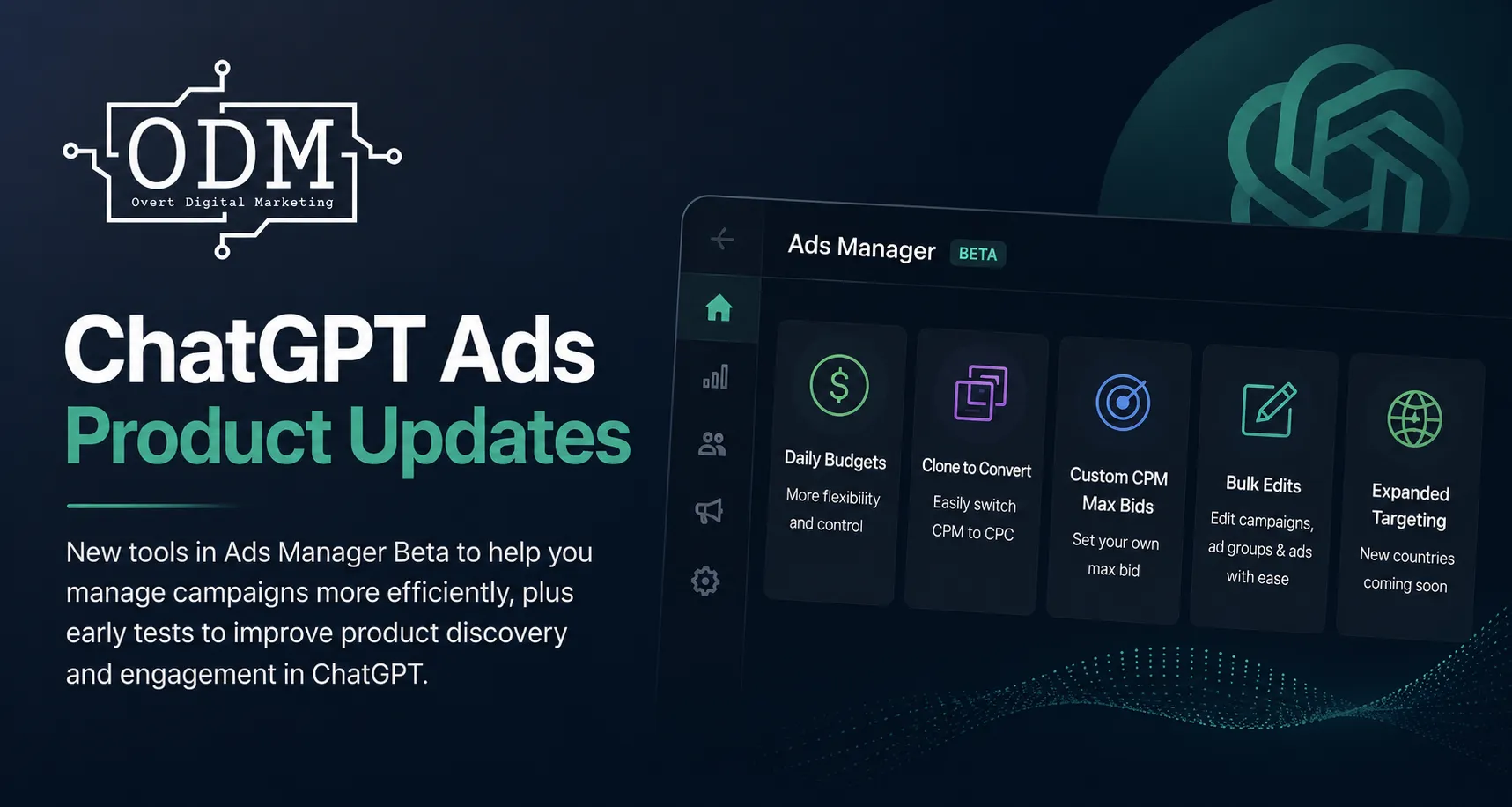
Organic visibility is only one way businesses can appear within ChatGPT. OpenAI has also introduced ChatGPT ads, creating a new paid advertising opportunity alongside AI-generated conversations.
It is important to separate the two. Advertising does not allow a business to pay to influence ChatGPT’s answers or improve its organic recommendations. Ads are displayed separately from ChatGPT’s responses and provide businesses with a paid opportunity to reach users when their products or services are relevant to the conversation.
This creates a very different advertising environment from traditional search. Google Ads has historically been built around search intent, keywords and auctions, while ChatGPT Ads can use the context of a conversation to determine when an advertisement may be relevant. Someone may not explicitly search for a particular business or product but could reveal strong commercial intent through the questions they ask during a conversation.
For advertisers, this means understanding context and customer intent becomes increasingly important. The opportunity is not simply to bid on another set of keywords. It is to reach potential customers while they are researching a problem, comparing options or moving towards a decision.
Businesses already investing in Google Ads and social ads should therefore view ChatGPT Ads as an additional channel rather than a replacement. Google Ads remains highly effective at capturing existing search demand, while social advertising can generate awareness and reach audiences based on interests and behaviour. ChatGPT Ads introduces another opportunity: reaching people within the conversations they are using to research and make decisions.
As AI-assisted discovery continues to grow, the businesses best positioned to benefit will be those that understand both sides of the opportunity: building organic visibility within AI-driven search while also evaluating paid advertising opportunities as they develop.
Where AI Advertising Fits Into a Broader Strategy
AI visibility should not be treated as a standalone marketing tactic. The same foundations that help a business perform in traditional search, including strong website content, technical SEO, brand authority, accurate business information and a credible reputation, can also support how that business is discovered and understood across AI-driven search experiences.
This is where SEO, Answer Engine Optimisation (AEO) and Generative Engine Optimisation (GEO) begin to work together. Traditional SEO focuses on improving search visibility and earning clicks. AEO focuses on structuring content so it can provide clear answers to the questions people are asking. GEO takes this further by strengthening the authority, relevance and supporting signals that can help a brand or its content be referenced within AI-generated responses.
These disciplines should not operate in isolation. A detailed article answering an important customer question, for example, can target traditional search demand while also providing clear information that search engines and AI systems can interpret. Building authority around that content through relevant third-party mentions can strengthen the wider digital footprint again.
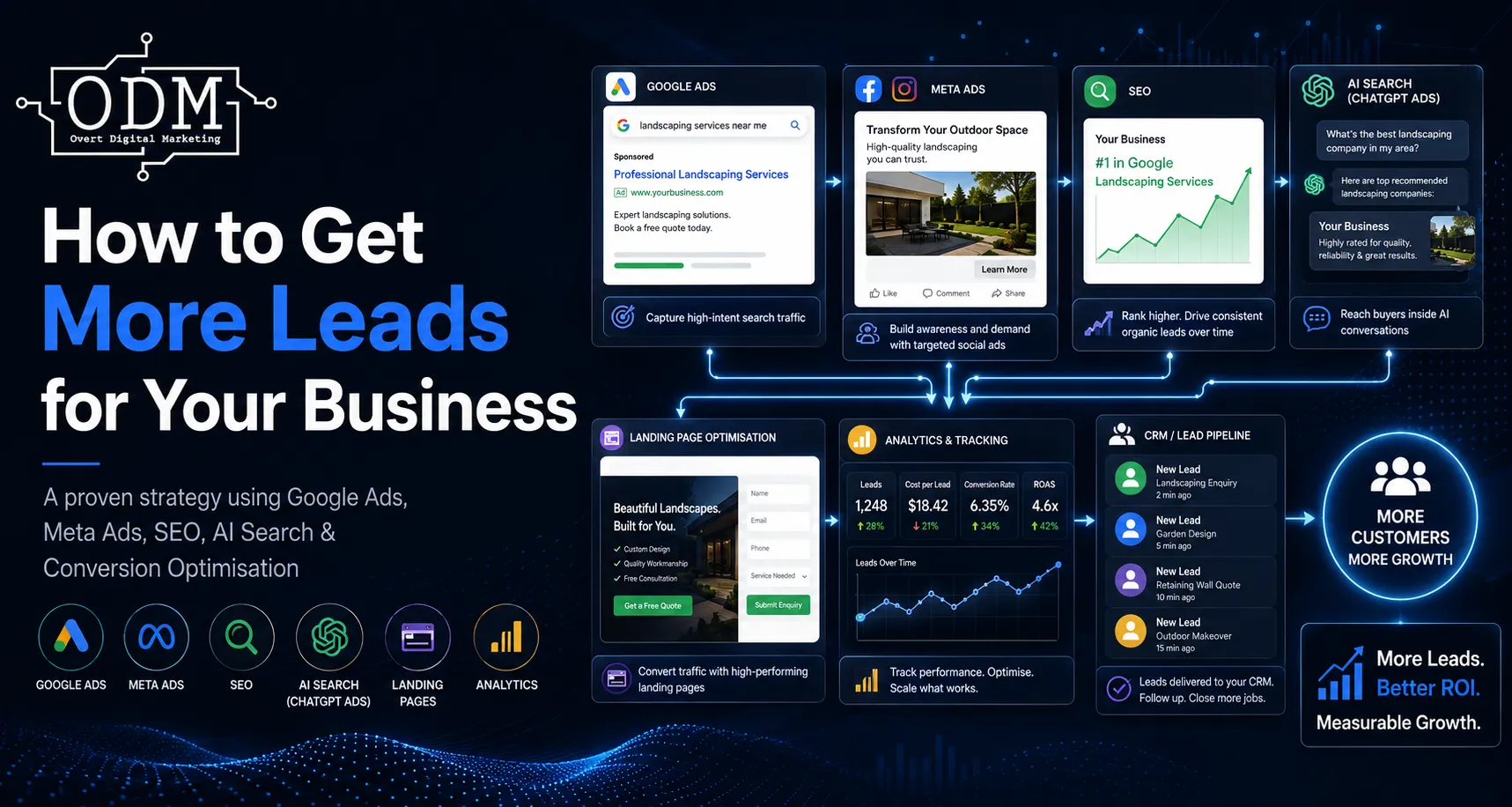
Paid media then adds another layer. Google Ads, social advertising and emerging channels such as ChatGPT Ads allow businesses to reach potential customers through paid placements, while SEO, AEO and GEO work on strengthening organic visibility and authority over time.
The strongest strategy is therefore not to abandon SEO for AI or shift advertising budgets simply because a new platform has emerged. It is to understand how customer discovery is changing and build a digital presence that can perform across traditional search, AI-generated answers and paid advertising channels.
How Overt Digital Marketing Approaches AI Visibility
At Overt Digital Marketing, we do not treat AI visibility as a replacement for SEO or as a standalone tactic designed to “game” ChatGPT. We look at the broader digital footprint that search engines and AI systems can discover, understand and use when evaluating information about a business.
This starts with the fundamentals. We assess technical SEO, website content, structured data, search visibility and the consistency of information about a business across relevant third-party sources. From there, we identify opportunities to strengthen topical authority, answer the questions potential customers are actually asking and build content that works across traditional search and AI-driven discovery.
Our approach brings SEO, AEO and GEO together rather than treating them as competing strategies. The objective is to improve how clearly a business and its expertise are represented online, while creating useful content that can perform in search results, answer-driven experiences and AI-generated conversations.
Paid media can then complement that organic foundation. With experience across Google Ads, social advertising and emerging platforms such as ChatGPT Ads, ODM can consider where each channel fits within the customer journey rather than shifting budget towards a new platform simply because it is generating attention.
AI search will continue to evolve, and there is no guaranteed formula for getting a business recommended by ChatGPT. What businesses can control is the strength, accuracy and authority of their digital presence. That is where we focus.
Building Long-Term AI Visibility
Improving visibility in ChatGPT and other AI-driven search experiences is not a one-off optimisation exercise. Search technologies, AI platforms and the ways people discover businesses continue to change, which means the information surrounding a brand needs to evolve as well.
Businesses should continue developing useful content around the products, services and questions that matter to their customers. Existing content should also be reviewed as information changes, while business listings, reviews, structured data and other important digital assets should remain accurate and current.
It is equally important to monitor how customer search behaviour is changing. People are increasingly able to ask detailed, conversational questions rather than relying on short keyword searches. Understanding those questions can reveal new content opportunities and help businesses build authority around the topics most closely connected to their products, services and expertise.
There is no guaranteed method for ensuring your business will always be recommended by ChatGPT. The more practical objective is to build a strong and authoritative digital presence that gives search engines and AI systems accurate, useful and credible information to work with.
At Overt Digital Marketing, we help businesses adapt their digital strategies as search and AI continue to evolve. If you want to understand where your business currently stands and identify opportunities to improve your visibility across traditional and AI-driven search, get in touch with Overt Digital Marketing today.
FAQs
How long does it take to improve a business’s visibility on ChatGPT?
There is no fixed timeframe. ChatGPT and other AI search experiences can discover and retrieve information from different sources, and there is no guaranteed process for making a business appear in an AI-generated response. Improving website content, search visibility, third-party authority and the overall digital presence of a business should therefore be viewed as an ongoing strategy rather than a campaign with a defined ranking deadline.
Is getting recommended by ChatGPT the same as ranking on Google?
No. Traditional SEO focuses on improving visibility within search engine results, while ChatGPT can generate answers by synthesising information from multiple sources. However, the two are closely connected. Strong website content, technical SEO, authority and accurate business information can support both traditional search performance and broader AI search visibility.
Can I pay to get my business recommended by ChatGPT?
No. ChatGPT Ads and organic ChatGPT responses are separate. Paying for advertising does not allow a business to influence ChatGPT’s answers or improve the likelihood of being organically recommended. ChatGPT Ads provide a separate paid opportunity to reach users when an advertisement is relevant to their conversation.
Can small businesses compete with larger brands for AI visibility?
Yes. A larger brand does not automatically have to be the most relevant answer to every question. A smaller business with strong expertise, useful content, credible reviews and clear information about its services and locations may be highly relevant to specific customer queries. This can be particularly important for local and specialist businesses where relevance and expertise matter more than brand size alone.
Does structured data help with ChatGPT visibility?
Structured data can help machines interpret information about a business, but schema markup alone will not make a business appear in ChatGPT. It should be considered part of a broader technical SEO strategy that makes important information about a website, organisation, products or services clearer and easier for digital systems to understand.
By Manesh Ram, Digital Marketing Specialist. Please follow @maneshram & Meta