
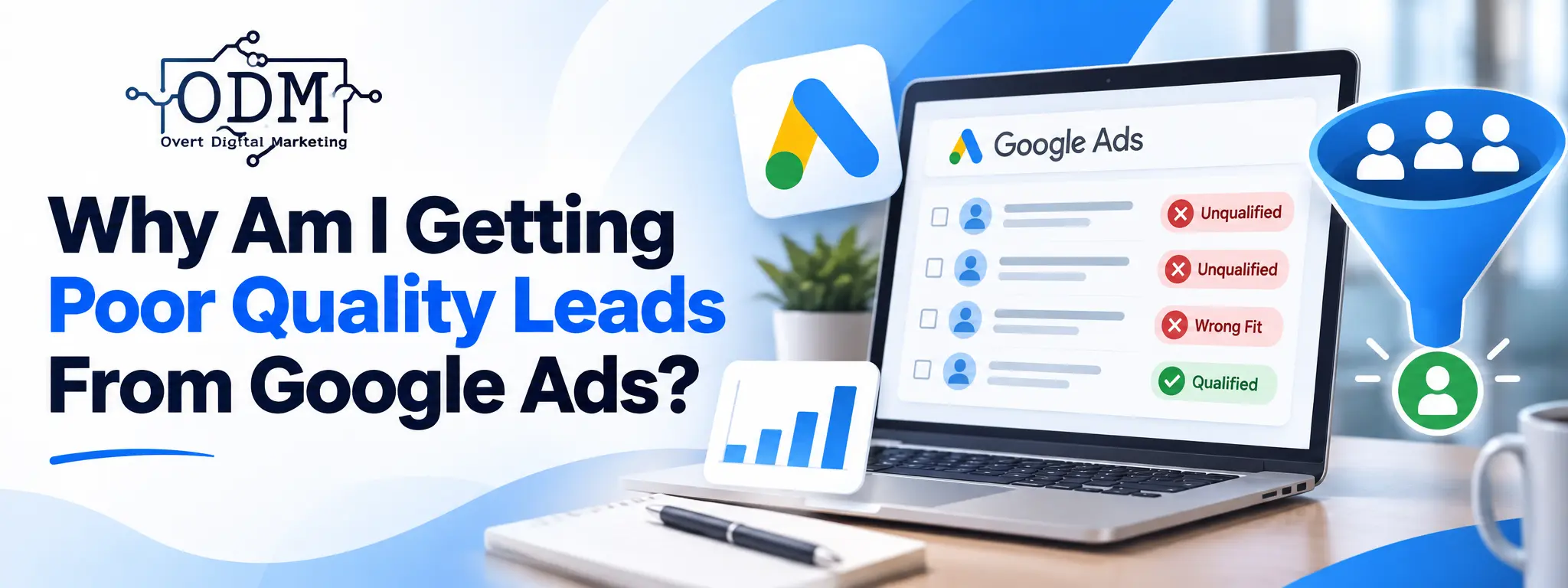
Poor-quality Google Ads leads usually occur because campaigns are optimising towards the wrong conversion signals, reaching searches or audiences that are too broad, or failing to qualify prospects before they enquire. Businesses may receive a steady stream of form submissions and phone calls without generating enough relevant sales opportunities. The problem is not necessarily a lack of traffic. It may be that the advertising is attracting the wrong people or measuring success incorrectly.
The distinction between lead volume and lead quality is critical. Google Ads can report a conversion whenever a configured conversion action occurs, but that does not automatically mean the person is a suitable prospect or likely to become a customer. To identify the cause, businesses need to examine what people searched for, how campaigns are targeting them, which conversion actions are being recorded and what happens after an enquiry reaches the sales team. These insights help determine whether the issue lies in campaign settings, measurement, lead qualification or the follow-up process.
Can Broad Keywords Cause Poor-Quality Google Ads Leads?
Broad keywords can attract people whose intentions differ significantly from those of your ideal customers. Google Ads uses keyword match types to determine which searches may trigger an advertisement, but matching is not always based on the literal words a person enters. Google’s keyword matching is not always based on the literal words a person enters. Phrase match can include searches that share the meaning of a keyword, while broad match can use additional signals and Google’s interpretation of intent to identify potentially relevant searches. As a result, a keyword that appears commercially relevant can still generate traffic from people researching unrelated topics, seeking free resources or looking for something your business does not provide.
For example, a commercial training provider advertising forklift training could receive searches related to forklift jobs, free forklift courses, forklift salaries, forklift hire or forklift training jobs. Some of these searches may be relevant to other businesses, but they are unlikely to produce suitable enrolment enquiries for a paid training course. Reviewing the Search terms report helps identify these mismatches. Advertisers can then refine keyword targeting, test more appropriate match types and add relevant negative keywords to exclude unsuitable searches. This review should be ongoing because the quality of search traffic can change as campaigns accumulate data and matching behaviour evolves.
Can Your Google Ads Copy Attract the Wrong Customers?
Ad copy can generate clicks and enquiries while setting expectations that do not match your actual offer. If an advertisement uses vague claims, promotes a service without explaining its scope or fails to communicate important eligibility requirements, people may enquire based on an incorrect understanding of what you provide. The same problem occurs when an ad promises something that the landing page does not clearly deliver. In these cases, the campaign may attract attention without attracting suitable prospects.
Review your headlines, descriptions and calls to action against the enquiries you receive. Make the service, intended audience and relevant conditions clear wherever appropriate. If you serve businesses rather than consumers, for example, the advertisement should make that distinction apparent. The landing page should reinforce the same message and explain the next step. Effective ad copy is not simply designed to encourage clicks. It helps the right prospects recognise that your offer is relevant while allowing unsuitable prospects to identify a mismatch before they submit an enquiry.
Is Your Google Ads Targeting Too Broad?
Geographic targeting can contribute to poor lead quality when campaign settings do not reflect where your business can operate. Google Ads distinguishes between people who are in or regularly in a targeted location and people who have shown interest in that location. Depending on the location options selected, an advertiser targeting a particular Australian city or region may reach people who are interested in that area but are not physically there or regularly present. This can create irrelevant enquiries for businesses that only serve customers within a defined service area.
Review the location options in your campaign rather than checking only the list of selected regions. If your business needs customers to be physically located in a particular area, the presence-based targeting option may be more appropriate than an option that also includes people showing interest in the location. The right choice depends on whether you serve local customers, operate nationally or sell services remotely. Also examine audience settings, campaign structure and the types of enquiries generated by each region. Use actual lead outcomes to refine targeting rather than assuming that a larger geographic audience will automatically produce better results.
Is Google Ads Optimising Towards the Wrong Conversions?
Google Ads uses the conversion goals and conversion actions selected for campaign optimisation to inform automated bidding. If a campaign records 50 enquiries as successful conversions but 40 are irrelevant, the system may continue seeking people likely to complete the same tracked action. Unless the campaign receives meaningful information about lead quality, it cannot reliably distinguish between a genuine sales opportunity and an enquiry that has no commercial value. This is why a high conversion count can coexist with poor business results.
Review which actions are classified as primary conversions and used for bidding, and which are secondary actions intended mainly for observation. Form submissions, genuine phone calls, call-button clicks, duplicate events and minor website interactions should not automatically be treated as equally valuable. Check that conversion tags fire correctly, that duplicate tracking is not inflating results and that micro-conversions, such as viewing a page, are not mistakenly driving bidding decisions. A submitted form may be a useful initial signal, but a qualified lead or completed sale provides stronger evidence of commercial value. The conversion setup should reflect the outcome the campaign is genuinely intended to achieve.
How Can CRM and Offline Conversion Data Improve Lead Quality?
Connecting Google Ads with your customer relationship management (CRM) system can help close the gap between online conversions and actual sales outcomes. An effective process follows the lead beyond the initial enquiry: Google Ads generates a lead, the details enter the CRM, the sales team assesses its suitability, and the resulting qualification status or sale value is passed back to Google Ads where supported. This gives the platform a more informative signal about which enquiries represent genuine opportunities, rather than treating every submission as equally successful.
This process commonly involves importing offline conversions or using supported enhanced conversions for leads, depending on the business’s tracking setup and available data. Qualified lead status, sales progression and conversion values can help inform bidding when they are implemented correctly. The CRM records, Google Ads conversion actions and imported events must be configured consistently to avoid duplicate or inaccurate reporting. Not every business has enough reliable data to optimise directly towards sales from the outset, but improving the connection between advertising and sales outcomes creates a stronger foundation for lead generation. It also helps businesses assess campaigns based on the value of the opportunities they generate, rather than relying exclusively on cost per enquiry.
Is Your Landing Page Failing to Qualify Leads?
A landing page should help prospective customers understand the offer and decide whether it meets their needs. If it provides little detail about the service, leaves important requirements unclear or makes broad promises, visitors may submit enquiries without being suitable customers. The conversion rate alone cannot reveal whether this is happening. A page that produces more submissions may still perform poorly if most enquiries are irrelevant or unlikely to progress.
Lead forms can also play a direct role in qualification. Short forms generally reduce the effort required to enquire, while asking a few relevant questions can help filter out unsuitable prospects. The balance depends on the service and the information needed to assess an opportunity. A business might ask about location, project size, budget range, timeframe or the specific service required. For an agency, asking about monthly advertising budget may help establish whether a prospective client is a suitable fit. The objective of conversion rate optimisation is not always to maximise form submissions. For lead generation, it should be to increase valuable enquiries without creating unnecessary barriers for suitable prospects.
Could Spam and Fake Enquiries Be Affecting Lead Quality?
Not every poor-quality lead results from weak keyword targeting or an unsuitable audience. Some enquiries may be spam, automated bot submissions, fake contact details, job applications, unsolicited sales pitches or messages containing meaningless information. These contacts require a different response from genuine prospects who simply do not match your target market. If a campaign is receiving automated submissions, changing keyword match types alone is unlikely to resolve the underlying problem.
Start by reviewing the actual enquiries and looking for repeated patterns, such as identical messages, suspicious submission bursts, invalid contact details or multiple records with the same characteristics. Check form protection, tracking implementation and the source of the submissions before deciding whether the problem is advertising-related. Where appropriate, improve spam filtering and form validation while preserving a straightforward experience for genuine customers. Separating spam from legitimate but unqualified leads also improves reporting, allowing you to identify whether the main issue is traffic quality, lead qualification or the integrity of the enquiry process.
Is Performance Max Generating the Poor-Quality Leads?
Performance Max requires a different diagnostic approach from a standard Search campaign. Search campaigns are organised around keyword targeting and search intent, whereas Performance Max uses automation to distribute advertising across eligible Google inventory and optimise towards the campaign’s objectives. This broader approach can help businesses reach potential customers in different contexts, but it also makes reliable conversion measurement and clear campaign goals particularly important.
If Performance Max is generating unsuitable enquiries, review the conversion actions used for bidding, the quality of the leads being recorded and the campaign’s available performance insights. Check whether the campaign is optimising towards genuine enquiries or weaker actions that are easier to generate. Where CRM integration and sufficient data are available, feeding qualified lead or sales outcomes back into Google Ads can provide stronger optimisation signals. Performance Max is not automatically responsible for poor lead quality, and switching campaign types will not necessarily fix the problem if the underlying conversion goals are inaccurate.
Should You Stop Google Ads If the Leads Are Poor Quality?
Not necessarily. Poor lead quality is a reason to investigate campaign performance, but it does not automatically mean Google Ads is the wrong channel for your business. The first step is to establish whether the problem comes from irrelevant search terms, overly broad location settings, misleading ad messaging, inaccurate conversion tracking, weak landing page qualification or the handling of enquiries after submission. Each cause requires a different response, and stopping campaigns before identifying the problem may mean losing access to a channel that could still generate valuable opportunities.
Other advertising channels may be worth considering when they better match how your customers discover services, but changing platforms will not automatically resolve an ineffective lead generation strategy. If the same weak qualification process and misleading success metrics are used elsewhere, the business may encounter similar problems. Make decisions using qualified lead rates, sales outcomes and cost per valuable opportunity, alongside the wider role advertising plays in your customer acquisition strategy. Where a campaign is consistently unprofitable, adjustments or a pause may be appropriate, but those decisions should be based on evidence rather than conversion volume alone.
How Overt Digital Marketing Approaches Lead Quality
At Overt Digital Marketing, we do not assess a lead generation campaign solely by the number of conversions reported in Google Ads. We look at what people searched, which campaigns and keywords generated the enquiries, what happened after each lead was submitted and, where the data is available, which leads became qualified opportunities or customers. That feedback helps identify whether the campaign needs changes to targeting, conversion measurement, messaging or landing page performance.
Our Google Ads services are relevant to businesses that need a clearer view of advertising performance and the relationship between campaign activity and commercial outcomes. The objective is to make informed optimisation decisions based on the quality of the opportunities generated, not simply to increase form submissions. If your campaigns are producing enquiries that rarely progress, you can contact Overt Digital Marketing to discuss your advertising requirements and the issues affecting your current results.
Frequently Asked Questions
Why am I getting poor-quality leads from Google Ads?
Poor-quality leads can result from irrelevant search terms, broad targeting, unclear ad messaging, inaccurate conversion tracking or insufficient qualification on your landing page. Some enquiries may also be spam or genuine prospects who are not ready to buy. Reviewing the actual enquiries alongside campaign settings and sales outcomes helps identify the most likely cause.
How can I improve Google Ads lead quality?
Start by reviewing search terms, excluding irrelevant queries with negative keywords and checking whether location settings match your service area. Ensure your advertisements and landing pages communicate the offer accurately, then verify that conversion tracking distinguishes genuine enquiries from weaker actions. Where possible, use CRM feedback to measure which leads become qualified opportunities and customers.
Can broad match cause poor-quality leads?
Yes. Broad match can reach searches based on Google’s interpretation of intent and context, not just the literal wording of a keyword. This can introduce irrelevant traffic when the campaign’s targeting or conversion signals are not sufficiently aligned with the business objective. Review the Search terms report regularly and use negative keywords where appropriate to reduce unsuitable traffic.
Can Performance Max generate poor-quality leads?
Yes. Performance Max can generate poor-quality leads if it is optimising towards conversion actions that do not represent valuable enquiries. Its broader inventory and automated delivery make reliable conversion goals particularly important. Review the campaign’s available performance insights and, where possible, use qualified lead or sales data to improve the signals informing optimisation.
Can conversion tracking affect lead quality?
Conversion tracking does not directly determine whether a prospect is suitable, but it strongly influences what Google Ads learns to pursue. If irrelevant submissions, duplicate events or low-value interactions are counted as primary conversions, automated bidding may prioritise those actions. Accurate tracking and meaningful conversion goals help align optimisation with business outcomes.
Should I use negative keywords to improve lead quality?
Negative keywords can prevent advertisements from showing for searches that are irrelevant to your offering. For example, a paid training provider may exclude terms associated with jobs or free courses if those searches do not align with its services. Negative keywords should be selected based on actual search behaviour and business requirements, with care taken not to exclude relevant commercial searches.
Can a landing page help qualify Google Ads leads?
Yes. A landing page can set clearer expectations by explaining the service, intended audience and relevant requirements before visitors enquire. A form that requests a small amount of useful qualifying information can also help identify suitable prospects. The aim is to generate more valuable enquiries, rather than simply maximising the number of completed forms.
How can I tell Google Ads which leads are actually qualified?
Where the required tracking setup and data are available, you can connect Google Ads with your CRM and import qualified lead or sales outcomes as offline conversions. This creates a link between the initial enquiry and what happens afterwards. Correct implementation is essential to ensure the imported events are accurate and not counted twice. These additional signals can help Google Ads optimise towards more commercially valuable outcomes.
Should I stop Google Ads if the leads are poor quality?
Not automatically. First, investigate whether the issue stems from targeting, search intent, conversion tracking, landing page qualification or sales follow-up. If the campaign can be improved, targeted adjustments may restore its value. If reliable performance data shows that it cannot meet your business objectives, reducing or pausing spend may be appropriate.